Black Friday 2026: The TMS Checklist to Avoid Year-End Logistics Chaos

Black Friday 2026: why you need to start planning today
Friday, November 27, 2026 is fast approaching, bringing with it a wave of logistics challenges. Between Black Friday, Cyber Monday and the Christmas marathon that follows, shipping volumes for e-commerce businesses can double or even triple over six consecutive weeks. For carriers and operations managers, this period represents both a major business opportunity and a significant operational risk.
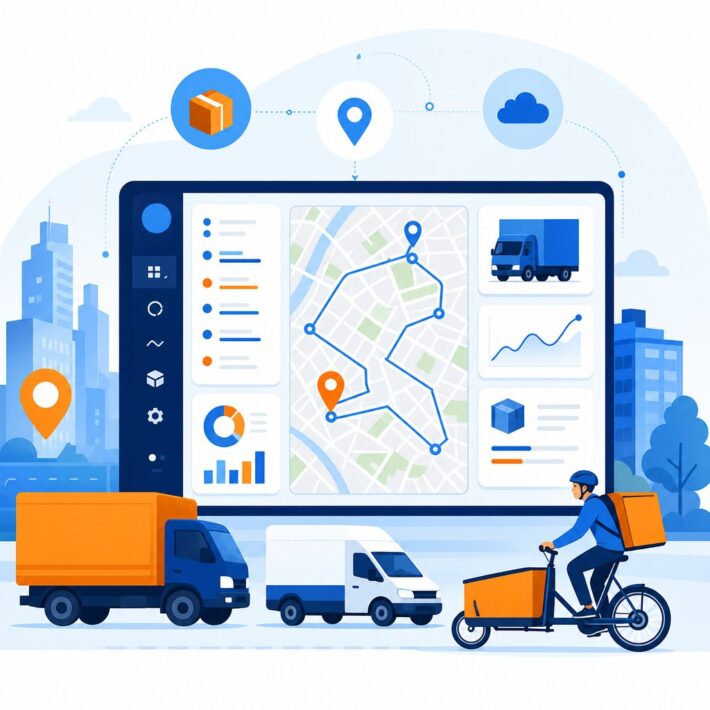
Lessons learned from previous years are clear: the companies that struggle through the peak are those that didn’t plan ahead. Conversely, those that turn this rush into a competitive advantage all share one thing in common: they rely on a TMS (Transport Management System) configured in advance, with automated rules, proactive alerts, and real-time visibility across the entire supply chain.
Here’s the complete checklist of 7 best practices to put in place before November 27 to confidently tackle the 2026 year-end peak.
Best practice #1: automate your dispatch rules
During normal periods, an operator can manually manage the assignment of jobs to drivers or subcontractors. During peak periods, this is simply impossible. With 300 to 500 additional transport orders per day, manual dispatch becomes a bottleneck.
The solution is to configure automatic dispatch rules that assign each mission based on predefined criteria:
- Delivery geographic zone
- Required vehicle type (temperature-controlled, tail-lift, light commercial vehicle)
- Remaining capacity of the driver or subcontractor
- Performance history (first-attempt delivery rate)
- Customer priority (SLA contract, express, standard)
Test your rules starting in mid-November on a representative sample. You’ll identify the edge cases that fall outside your logic and can refine the parameters before volumes explode.
Best practice #2: optimize your routes with multi-constraint logic
Route optimization is no longer just about minimizing kilometers driven. In 2026, a good optimization engine must simultaneously integrate numerous constraints: customer time windows, regulatory driving times, low emission zones (LEZ), volumetric and weight capacity, driver skills, and charging points for electric vehicles.
A well-configured multi-constraint algorithm can deliver 15 to 25% productivity gains during normal periods, and up to 35% during peak periods when the density of delivery points mechanically increases.
In November 2024, a regional carrier handled 42% more volume with only 12% additional resources thanks to multi-constraint optimization activated three weeks before the peak.

Best practice #3: trigger proactive notifications
During Black Friday, 70% of inbound customer service calls concern a single question: “Where is my package?”. Each call ties up an agent for 3 to 7 minutes. Multiply this by the volume of requests and you’ll understand why your support teams collapse by the second week.
The solution is simple: proactive notifications automatically sent to the recipient at each key stage of the package journey.
The 5 essential notifications
- Pickup confirmation at the shipper
- Out-for-delivery notice on the morning of delivery with a 2-hour window
- “Your driver arrives in 30 minutes” alert with geolocation
- Delivery confirmation with proof photo
- In case of failure: immediate rescheduling proposal
These notifications reduce inbound calls by 60 to 80% and significantly improve customer satisfaction, even when an incident occurs.
Best practice #4: pre-invoice your reinforced subcontractors
During peak periods, you’ll likely rely on temporary subcontractors or reinforce your existing agreements. Be careful: the administrative management of these reinforcements is often underestimated. In January 2027, you risk spending weeks reconciling invoices, delivery notes, and hastily negotiated rate conditions.
Best practice is to set up an automatic pre-invoicing system now: each mission performed by a subcontractor generates a pre-invoice line validated by your operations teams, with the negotiated rate, any penalties or bonuses, and attached supporting documents.
This system offers three major benefits: you pay your partners on time (crucial to maintaining their loyalty the following year), you avoid billing disputes in January, and you have an accurate view of your unit transport cost during the peak.
Best practice #5: track your KPIs in real time
Managing operations on a weekly or monthly basis during a volume peak is like driving blindfolded. You need real-time visibility on key indicators:
- First-attempt delivery rate (target: > 92%)
- Number of unassigned missions at end of day
- Time window compliance rate
- Average time between pickup and delivery
- Incident rate by type (incorrect address, absent, refusal)
- Average cost per delivery (internal vs subcontracted)
A dashboard updated every 15 minutes allows you to immediately detect a drift: agency saturation, structurally late driver, under-resourced geographic zone. You can then react within the hour, not the next day.
Best practice #6: verify your PODs with artificial intelligence
The POD (Proof Of Delivery) is the cornerstone of billing and dispute management. During the peak, your drivers under pressure sometimes rush through delivery proofs: blurry photos, missing signatures, poorly scanned barcodes.
Modern TMS platforms now integrate real-time AI-powered POD verification: as soon as a driver validates a delivery, artificial intelligence checks photo quality, the presence of a legible signature, and the match between the photographed package and the tracking number. If something is wrong, the driver is alerted immediately and can retake the proof before leaving the site.
The result: in January 2027, you’ll no longer spend three weeks searching for missing PODs to dispute customer claims or justify your invoices.

Best practice #7: anticipate the driver shortage
This is the topic that keeps the entire industry awake at night: the structural driver shortage. During peak periods, it becomes critical. Temporary staffing platforms are fully booked by early November, and daily rates soar by 30 to 50%.
Three levers to secure your resources
- Retain existing drivers by guaranteeing them optimized routes, ergonomic mobile tools, and clearly defined peak bonuses
- Pool resources with non-competing peers in certain geographic zones
- Diversify profiles by integrating light vehicles driven by self-employed contractors for urban last-mile deliveries
A TMS platform capable of managing salaried drivers, subcontractors, and self-employed contractors interchangeably will give you the flexibility needed to handle resource constraints in real time.
How Everest supports you for the 2026 peak
At Everest, we designed our TMS with one obsession: enabling operators to stay in control, even when volumes explode. The 7 best practices in this checklist correspond directly to native features of the platform.
Our fully configurable dispatch rules, our multi-constraint optimization engine integrating LEZ and CSR constraints, our multi-channel proactive notifications (SMS, email, WhatsApp), our automatic pre-invoicing module for subcontractors, and our AI-powered POD verification form an ecosystem designed for peak activity.
Our teams support each client in configuring their pre-peak environment: rules audit, load testing, training operators on real-time dashboards. The goal is clear: turn Black Friday 2026 into a performance showcase, not a crisis management exercise.
Conclusion: three weeks to change everything
Black Friday 2026 won’t wait. Three weeks out, every day counts to configure, test, and train. Carriers who approach the peak with a completed and validated checklist will make the difference, not only on their November and December figures, but also on the loyalty of their e-commerce customers in 2027.
The real competitive advantage is no longer the ability to absorb the shock, but the ability to turn it into an opportunity: deliver better than competitors, communicate more clearly with recipients, and finish the season with preserved profitability. This is the entire challenge of a modern, well-configured TMS used by trained teams. There’s still time to act.