Delivery Management Software: The Complete Guide to Making the Right Choice in 2026
Repeated customer calls, routes built by hand on Excel, lost proofs of delivery, invoicing that takes three weeks… If this daily routine sounds familiar, it’s time to switch to a delivery management software. Carriers, retailers, cargo-bike logistics providers: they all now have access to tools capable of automating dispatch, optimizing routes and offering real-time tracking to their customers. But you still need to choose the right one. Here’s everything you need to know to make the right choice in 2026.
What is a delivery management software?
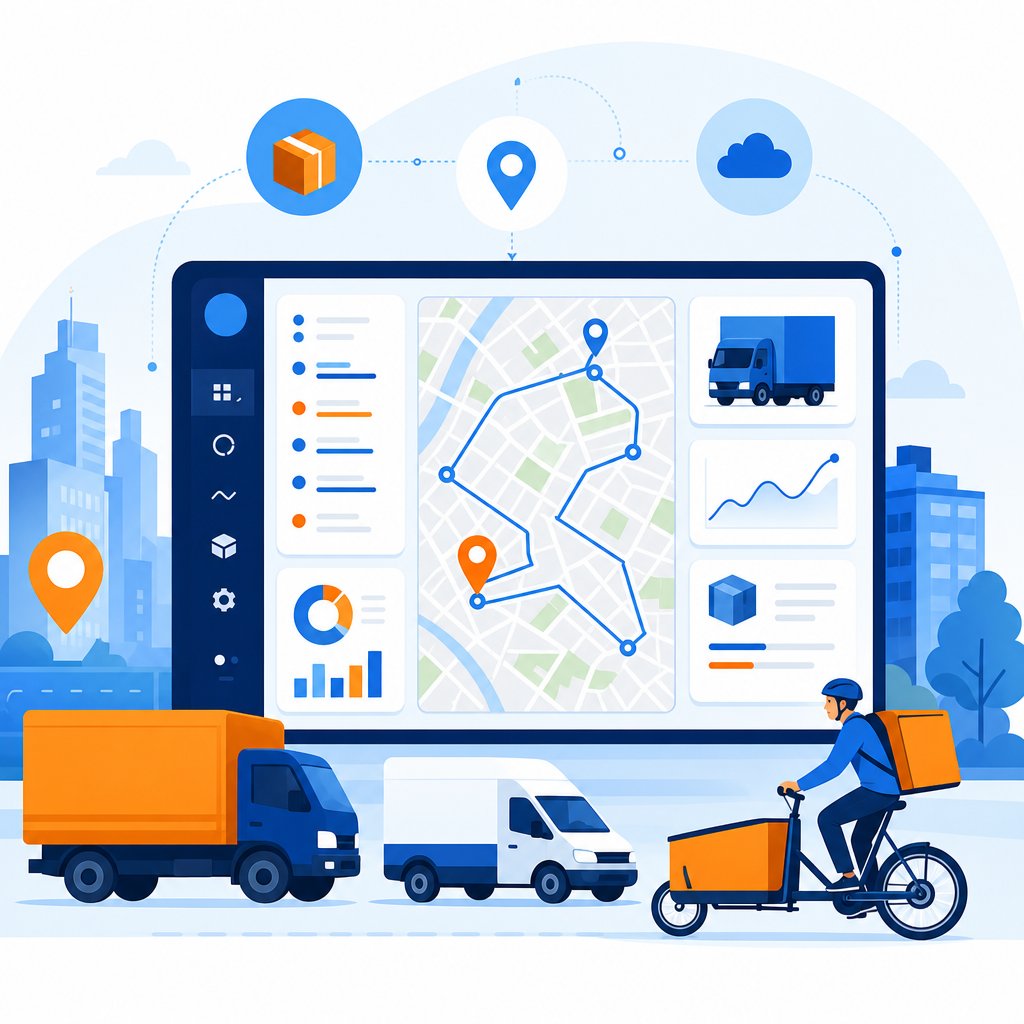
A delivery management software centralizes every step of a delivery in a single interface: from order intake to invoicing, including driver assignment, real-time tracking and proof of delivery collection.
It is also referred to as a TMS (Transport Management System) or dispatch software. Concretely, it replaces the traditional trio of spreadsheet + phone + paper with a connected tool, used by:
- operations managers and dispatchers, through a web interface;
- drivers, via a mobile application;
- end customers or shippers, via notifications, a tracking link or a customer portal.
A good software doesn’t just store information: it automatically circulates it between all stakeholders, without re-entry.
6 signs it’s time to get equipped
Still hesitating? If you tick at least two of these situations, your current organization is already costing you more than a software would.
- Your dispatcher spends their day on the phone handing out missions and answering “where is my package?” calls.
- Your routes are built by hand, on Excel or on paper, every morning.
- Orders come in by email, SMS and phone, with re-entry errors along the way.
- Your proofs of delivery are paper slips that get lost or arrive unreadable.
- Your invoicing takes several days at the end of each month.
- You have no reliable figures on your delivery rate, your delays or your cost per mission.
Good news: each of these pain points has a simple software answer, with no development required.
Must-have features of a delivery management application
Not all tools are created equal. Here’s the foundation to require, whatever your business.
Centralized order intake
A customer portal where your shippers create their own missions, an API to receive orders from your e-commerce site or ERP, file imports for one-off volumes. The goal: zero re-entry.
Manual and automatic dispatch
The dispatch software must offer list, map and planning views, as well as automatic assignment rules by customer, zone or service type. Missions arrive directly on the driver’s smartphone via push notification.
Route optimization
An engine capable of calculating the optimal route taking into account multiple constraints: time slots, weight, volume, vehicle types, driver skills. This is often the feature with the fastest ROI, with up to 30% in operational cost savings.
Real-time tracking and traceability
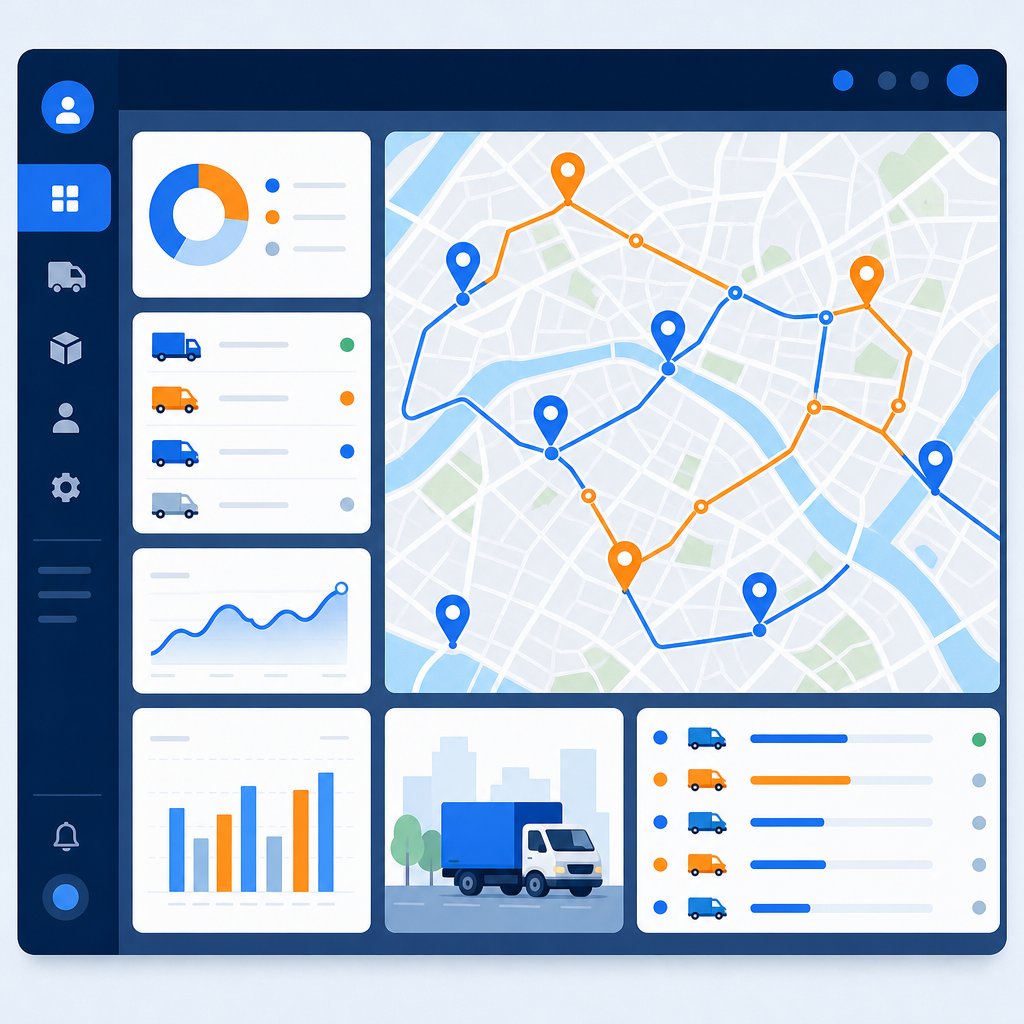
- driver geolocation;
- dynamic ETAs continuously recalculated;
- customizable statuses;
- internal alerts in case of delay risk.
Digital proofs of delivery
Photos, signatures, package scans: PODs are uploaded instantly and archived automatically. No more lost paper slips and endless disputes.
Customer notifications
SMS, email or push, with real-time tracking link, rescheduling link and rating link. Ideally in white label, in your colors.
Automated invoicing
Pricing grids by customer (weight, distance, volume, number of packages, fuel surcharge…), periodic invoicing, subcontractor pre-invoicing, online payment and automatic reminders.
Reporting and KPIs
An interactive dashboard to track your delivery rate, your delays, your volume per customer or your CO2 emissions, with data export to your BI tools.
Carrier, retailer, cargo-bike logistics: different needs
The same delivery planning software can serve very different businesses, provided it is configurable. Here are the priorities for each profile.
For carriers
The challenge is to get off the phone. Missions are sent to the mobile app, statuses come up automatically, customers order from their dedicated portal. Result: 1 to 2 hours saved per day on dispatch, as at Eagles Courses. Priority features are automatic dispatch, the driver app, pricing grids and automated invoicing.
For retailers
Delivery has become a commercial argument. 43% of consumers abandon their cart if the delivery options don’t suit them. The e-commerce transport management software must therefore allow you to offer several delivery times, connect several carriers and polish every white-label notification.
For cargo-bike logistics
Cargo-bike routes require fine optimization (reduced capacity, pedestrian zones, multiple stops) and the ability to prove CO2 savings to your customers via accurate exports.
How to choose your delivery software?
Beyond the feature list, these are the criteria that will make the difference day to day.
Deployment speed
A good tool is set up in a few days, not several months. Be wary of projects requiring long specifications and specific developments.
Simplicity for drivers
If the mobile app is complicated, your drivers won’t use it. Check iOS and Android compatibility, integration with Google Maps or Waze, and the ability to use professional terminals such as Zebra devices.
Integration capability
Documented REST API, webhooks, no-code connectors (Zapier, Make, n8n): your software must communicate with your ERP, your e-commerce site and your partners without a heavy IT project.
White label
Your customers must see your brand, not the vendor’s: domain name, colors, notifications, invoices and delivery notes with your logo.
Scalability
Going from 3 to 30 drivers, opening a new city, adding a site: the tool must keep up without a redesign.
The price of a delivery management software
Most solutions work on a SaaS subscription basis, calculated according to the number of drivers, missions or activated modules. Rather than comparing only the monthly price, calculate the return on investment: dispatch time saved, kilometers avoided, fewer customer calls, accelerated invoicing.
A few questions to ask during a demo:
- How long until I’m operational?
- Can I configure my own pricing grids without the vendor?
- How does the integration with my current tools work?
- What support is provided at launch?
- Can my data be exported?
AI, the new frontier of delivery software
In 2026, artificial intelligence is no longer a gimmick in delivery management software. It directly tackles the most time-consuming tasks:
- Automatic proof of delivery verification: AI checks signatures, photos and package condition in seconds, instead of 4 to 5 minutes per document.
- Conversational AI assistant: query your data, generate a report or create a mission in natural language.
- No-code business applications: describe a specific need (order form, customer tracking page, dock preparation) and get an app ready to share in minutes.
- Automated workflows: chain mission creation, dispatch, notification and invoicing without human intervention.
The software thus moves from a data entry tool to a true operational copilot.
Everest, the all-in-one delivery management software
Everest brings together in a single white-label platform everything carriers, retailers and cargo-bike logistics providers need:
- Manual or automatic dispatch, in list, map and planning views;
- Multi-constraint route optimization, with the Kardinal module;
- Sherpas, the driver mobile app on iOS and Android;
- Customer notifications via SMS, email and push, with branded tracking link;
- Automated invoicing, pre-invoicing and online payment via Stripe;
- Customer portal for self-service order intake;
- API, webhooks, Zapier and n8n to connect your entire ecosystem;
- Walter, the AI assistant, and Podchecker.ai for automatic POD verification.
“Everest was very simple to deploy. In two days, we had the software in our hands, we were able to enter our zones, our prices, deploy on the couriers’ phones.” — Sébastien de Sousa Lemos, Eagles Courses
“With Everest, we no longer need to be on the phone all day and it also means substantial savings just by digitizing transport slips and proofs of delivery.” — Issam Chaker, Speedcare
“Everest brought us interconnection with carriers, the ability to manage each delivery and finally notifications for our customers.” — Benoit Ribault, Rexel
Key takeaways
A delivery management software is no longer reserved for large groups. It is becoming the central tool for any player who delivers, whatever their volume.
To make the right choice, bet on three pillars: fast deployment, a smooth experience for your drivers and customers, and full openness to your existing tools. Delivery is your showcase: give yourself the means to make it flawless.