E-invoicing 2026: how to connect your TMS to your approved platform (Qonto, Pennylane…)
The e-invoicing reform is coming: what really awaits carriers
On September 1, 2026, the e-invoicing reform comes into force. All VAT-registered businesses will need to be able to receive electronic invoices, and large companies as well as mid-sized enterprises will already have to issue them. For carriers, cycle-logistics operators and distributors, the issue goes far beyond accounting: a transport invoice originates in the TMS, not in the accounting software. Which means the proper articulation between the two becomes strategic.
This guide breaks down what’s actually changing, why transport invoicing is a special case, and how to cleanly connect your TMS to an approved platform (Qonto, Pennylane and others) without re-keying or workflow disruption.
What actually changes on September 1, 2026
Two deadlines, two very distinct obligations
First thing to clarify: you need to distinguish reception from emission, because not everyone is in the same boat.
- September 1, 2026: all VAT-registered businesses must be able to receive electronic invoices. Large companies and mid-sized enterprises must additionally issue them and transmit their e-reporting data.
- September 1, 2027: the obligation to issue and e-report extends to SMEs, very small businesses and micro-enterprises.
In other words: even a ten-employee carrier is affected from September 2026. Its large-account clients will send it electronic invoices, and it will have to be able to receive them properly.
The PDF sent by email is over
An electronic invoice is not a PDF attached to an email. It’s a structured, machine-readable file, in one of the three core accepted formats: Factur-X, UBL or CII. Factur-X is the most widespread among SMEs because it combines a human-readable PDF with embedded XML data: you keep seeing a normal invoice, while the machine reads the data.
The approved platform becomes a mandatory gateway
This is the point that still surprises many companies. The Public Invoicing Portal no longer provides free invoice exchange: it only acts as a directory and data concentrator for the tax administration. All invoices must therefore transit through an approved platform (PA), formerly called PDP, registered by the DGFiP.
There are now more than 130, including Pennylane, Qonto, Sage, Cegid, Tiime and Sellsy. Each company must designate its own in the central directory: it’s this registration that will allow your customers and suppliers to know where to send their invoices to you.
Otherwise, the penalties are clear: €15 per untransmitted invoice and €250 per missing or erroneous e-reporting transmission, up to €15,000 per year for each category.
Why transport invoicing is a special case
On paper, the reform affects everyone in the same way. In practice, transport invoicing combines specificities that make compliance much more delicate than for a consulting firm that issues fifteen invoices a month.
Volume and granularity
A monthly transport invoice can aggregate several hundred missions, each with its own rate, options and surcharges. Manually re-keying this into an invoicing tool is simply unthinkable.
Complex rate grids
Price by weight, volume, distance, number of parcels, service surcharges, additional costs, exceptional pricing rules… Pricing a mission is a business calculation, not just a price line.
Fuel surcharge
Its calculation, its indexing method and its mention on the invoice are subject to obligations specific to road transport. It must appear correctly in the structured invoice, at the right level of detail.
Subcontractor self-billing
Many carriers operate on a self-billing basis with their partners. This flow must also go through an approved platform, with a proper self-billing mandate.
E-reporting
B2C deliveries and international services don’t fall under e-invoicing, but under transaction data transmission to the tax administration. A carrier that delivers to both retailers and individuals is therefore under both regimes at the same time.
Disputes
An invoice disputed for a missing proof of delivery blocks payment. With a dematerialized and time-stamped invoicing cycle, the discrepancy must be identified before issuance, not three weeks later.
The real division of roles: TMS on one side, approved platform on the other
This is the most frequent confusion right now, and it costs a lot of thinking time: your TMS is not meant to become an approved platform. These are two distinct businesses.
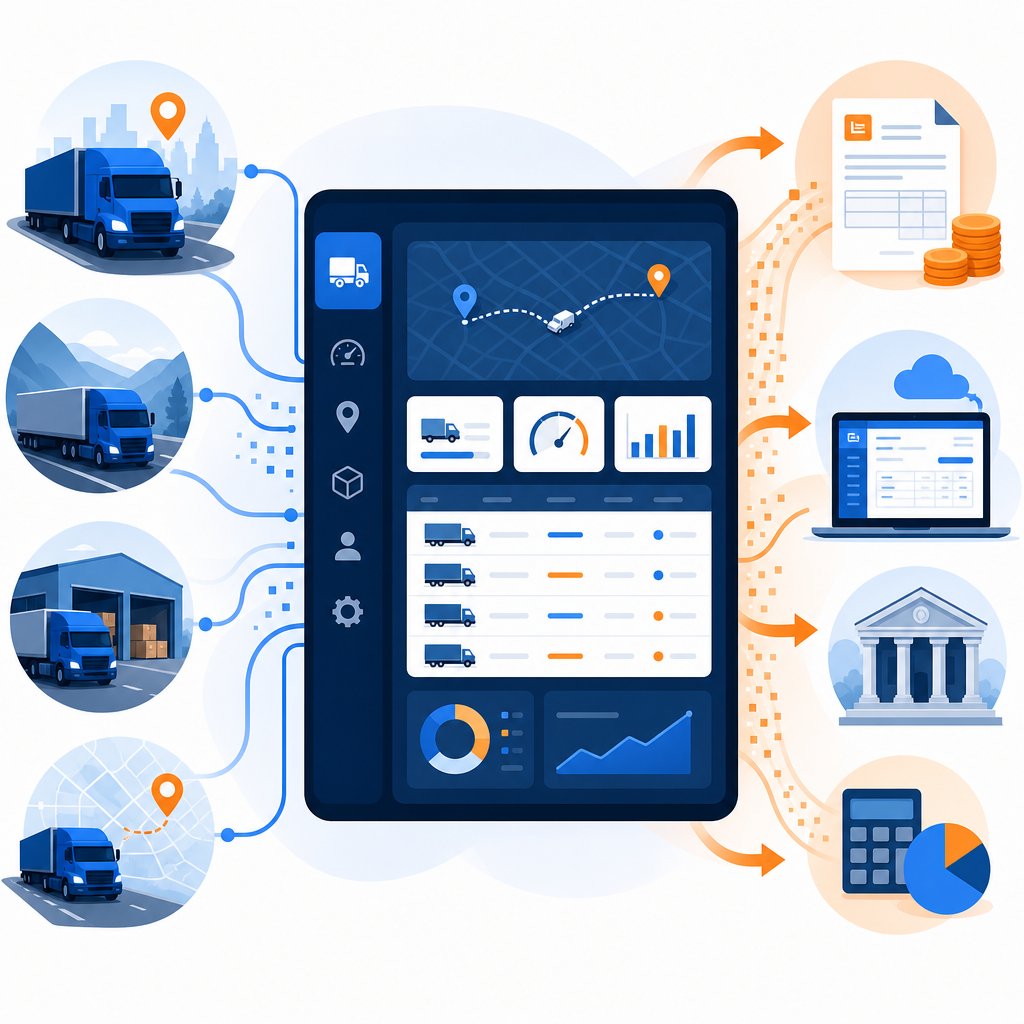
- The TMS is the pricing engine: it turns executed missions into accurate invoice lines, with the right rates, the right options, the right fuel surcharge and the right customer allocations.
- The approved platform is the trusted third party: it converts, transmits, time-stamps, and guarantees interoperability and the invoice lifecycle with the tax administration and your customer.
The TMS writes the invoice. The approved platform makes it circulate. What matters, therefore, is not that your TMS is registered, but that it cleanly feeds the platform of your choice, without re-keying and without workflow disruption.
How Everest fits into your setup
Everest was designed to slot into this architecture without locking you into a platform choice.
The expected formats, natively
Invoices generated in Everest can be exported in the formats relevant to the reform: Factur-X, PDF and CSV. You remain free in how you route them, and your invoicing data remains usable for your accounting as well as your BI tools.
Native integrations with Qonto and Pennylane
For the platforms most used by our customers, the integration goes further than export: invoices issued from Everest are deposited directly on the platform, and payment reconciliation flows back automatically. In practice, you generate your periodic invoicing in the TMS, it goes to Qonto or Pennylane, and you track collection without juggling three interfaces.
Any other compatible approved platform
Are you already working with another registered provider? Everest’s REST API, webhooks and automation modules (Zapier, n8n) let you build the bridge to the approved platform of your choice, or to the one imposed by your accounting firm.
To check before September 2026: the checklist
A short checklist so you don’t discover the topic after the summer break:
- Have you designated your approved platform in the central directory? It’s the prerequisite for receiving anything.
- Is your customer data up to date? SIREN, SIRET, billing addresses, mandatory statements: incorrect data means a rejected invoice.
- Is your invoicing automated upstream? If your invoices are still built in Excel from route exports, compliance won’t fix anything: it will just make the gap visible faster.
- Are your subcontractor self-billing flows properly framed? Self-billing mandates, frequency, discrepancy validation.
- Are your B2C and international flows identified? Those are the ones that fall under e-reporting.
- Has your accounting firm already decided? Many accountants have selected one platform for all their clients: it’s best to align.
Key takeaways
The reform is not a mere format change. For a carrier, it puts the quality of operational data at the center of the financial chain: a mispriced mission, a missing proof of delivery or a poorly filled rate grid immediately become an invoicing problem, and therefore a cash flow problem.
The good news is that companies already equipped with a TMS that automates their invoicing only have, in reality, one link to add: the connection to an approved platform. Others will have to tackle two projects at once, just weeks before the deadline.
The best time to automate your transport invoicing was a year ago. The second best time is now.