Cycle Logistics Software: The 5 Features That Matter (and What You Really Pay to Scale)
Why Big TMS Platforms Aren’t Built for You
When you type “cycle logistics software“ or “last-mile TMS pricing“ into Google, you almost always run into the same suspects: TMS platforms designed for road freight, solutions calibrated for heavy truck fleets, tools that charge you for modules you’ll never use (trailer management, customs, palletization, etc.).
If you run a cargo bike delivery operation, the problem isn’t the raw price of the tool. The real problem is that you’re paying for useless features while missing the ones that drive your daily work: urban constraints (pedestrian zones, one-way streets, bike parking), real-time multi-rider dispatch, proof of delivery on smartphone, quantified ESG arguments for your clients.
In short, a generic TMS costs you a lot to do the job badly. Let’s reframe the question properly: what software features actually matter when you’re riding a bike, and how much do you pay to get exactly that — no more, no less?
The 5 Software Features That Truly Matter in Cycle Logistics
Here are the features that separate a tool that holds you back from one that helps you scale. If your software doesn’t tick these boxes, it wasn’t built for you.
1. Real-Time Multi-Rider Dispatch
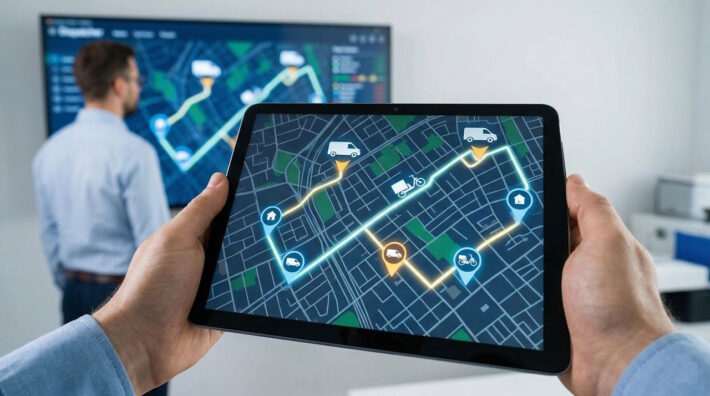
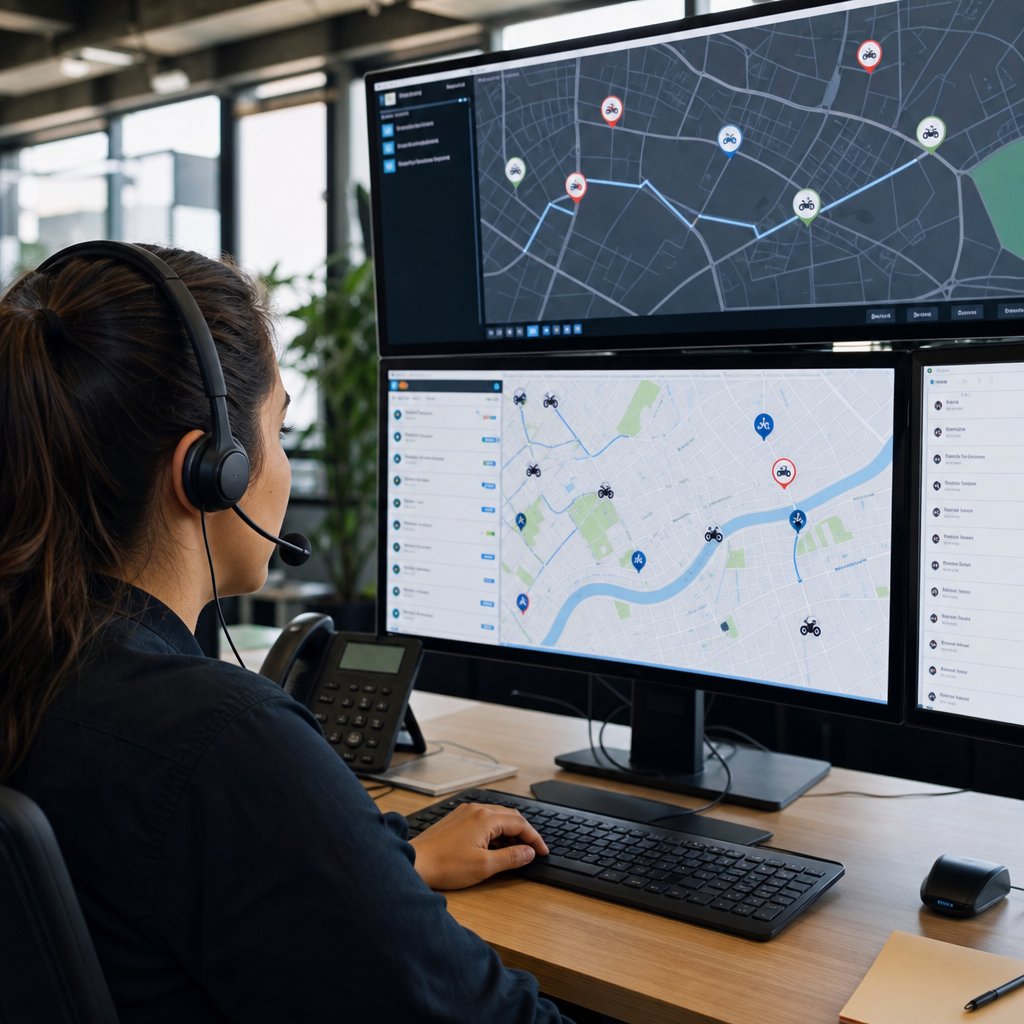
This is the core engine. You receive a delivery request, and you need to be able to assign it in seconds to the right rider — the closest one, the least loaded, or the one already heading into the zone. A good dispatch tool shows you:
- Live GPS position of every rider
- Their remaining capacity (volume, weight)
- Their ETA on the current job
- Automatic or manual assignment of a new mission
Road TMS platforms think in terms of “transport orders” assigned the day before. In urban cycle logistics, you think in continuous flow, sometimes minute by minute. It’s a different logic entirely.
2. Route Optimization Designed for the City
Optimizing a bike route has nothing in common with optimizing a truck route. The constraints are completely different:
- One-way streets that don’t apply to bikes (contraflow cycling lanes)
- Pedestrian zones accessible or banned depending on the hour
- Elevation (a flat detour often beats a direct climb)
- Secure bike parking points
- Delivery time windows (B2B in the morning, B2C in the afternoon, etc.)
An algorithm that ignores these parameters costs you 20 to 30% in productivity.
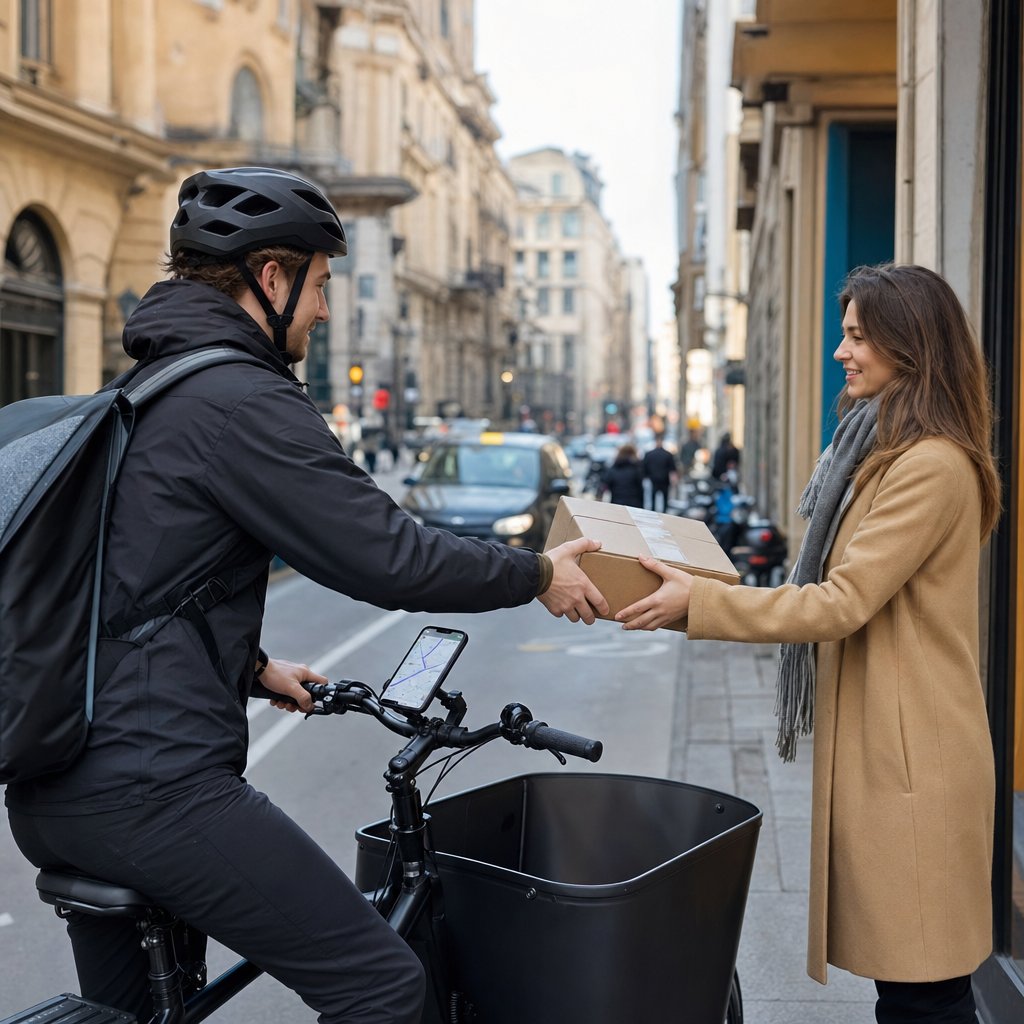
3. A Rider App With Field-Ready Proof of Delivery
Your rider doesn’t have time to pull out a handheld terminal, a scanner, and three sheets of paper. They have a smartphone, period. The app must let them:
- View today’s route with turn-by-turn navigation
- Mark a delivery complete in a single tap
- Capture a photo, signature, or code as proof
- Handle incidents (recipient absent, refused, wrong address)
Digital proof of delivery is also what protects you in case of a client dispute. Essential as soon as you invoice in B2B.
4. Automated Customer Notifications
The end customer (or the shipper) wants to know where their delivery stands — without calling your office. Automated SMS or email notifications (“order picked up,” “rider 5 minutes away,” “delivered, here’s the proof”) do two things: they cut your customer support by 50%, and they give your service a professional image.
5. CO2 Calculation and ESG Reporting
We’ll dive deeper below, but remember this now: it’s no longer optional. It has become a sales argument. If your software doesn’t automatically calculate emissions avoided per delivery and per client, you’re leaving money on the table.
What It Actually Costs: The Market’s 3 Pricing Tiers
Now that we know what we need, let’s talk numbers. The market breaks down into three very clear tiers.
Tier 1 — Free / Excel / WhatsApp ($0/month)
This is where everyone starts. A shared Google Sheet, a WhatsApp group for dispatch, Google Maps for routes. Direct cost: $0. Hidden cost: huge once you hit 2-3 riders. No proof of delivery, no traceability, no customer reporting, no CO2 calculation. You hit the ceiling fast and lose deliveries through disorganization.
Free is perfect for validating your market in the first 3 months. Beyond that, it costs you customers.
Tier 2 — Entry-Level Generic ($30 to $80 per rider/month)
You pick a generic TMS or courier software. You get dispatch, the rider app, sometimes route optimization. But:
- You pay per fixed rider seat, whether they ride or not
- Optimization doesn’t account for bike-specific constraints
- The CO2 module doesn’t exist or is a paid add-on
- You’re paying for truck features you don’t use
For 5 riders, you’re quickly at $250-400 per month. And you still don’t have a quantified ESG argument to sell.
Tier 3 — Full Enterprise Solution ($500 to $2000+/month)
Now we’re talking about big platforms like Urbantz, Shippeo, Woop, etc. Very powerful, but calibrated for industrial volumes (Carrefour, La Poste, etc.). Prohibitive entry cost when you’re starting out, multi-week setup, and once again, you’re paying for plenty of things that don’t serve a cargo bike.
The Game-Changing Model: Volume-Based Pricing
When you start small and want to scale without bleeding cash, volume-based pricing (per delivery handled) is by far the most logical:
- You pay only when you generate revenue
- No fixed per-rider cost dragging your margin down in low season
- You can test, hire a seasonal rider, or open a new city without recalculating your subscription
- The cost grows with your business, not before
It’s the model that matches the reality of a cycle logistics operator just starting out: irregular volumes, step-by-step growth, the need to test quickly.
The Argument Nobody Really Leverages: Decarbonization as a Sales Tool
You hear everywhere that cargo bikes are “good for the planet.” True, but poorly sold. The real issue isn’t morality — it’s the contract.
Your B2B prospects (e-commerce sites, retailers, restaurants, labs, etc.) now have non-financial reporting obligations (CSRD, GHG reporting, scope 3). They need to prove to their own customers and investors that they’re decarbonizing their supply chain. You, as a cycle logistics operator, are the solution to their problem.
But to sign the contract, they need numbers. Not a marketing pitch. Concrete data:
- How many kg of CO2 avoided per delivery, per month, per year
- A downloadable, clean report to plug into their reporting
- An upstream simulator to estimate savings before signing
- Dated and auditable proof of decarbonized deliveries
If your software produces all that in two clicks, you turn your bike into a deal-closing machine. If you have to recalculate manually in Excel, you lose the sale.
Why Everest Ticks Every Box (and Only Charges You for What’s Useful)
At Everest, we built the platform from exactly this observation: cycle logistics operators deserved a tool designed for them, not a watered-down road TMS.
Concretely, with Everest you get:
- Real-time multi-rider dispatch with geolocation and smart assignment
- Urban route optimization that integrates real bike-specific constraints
- The rider app with proof of delivery (photo, signature, code)
- Automated customer notifications via SMS and email
- A decarbonization module and a CO2 simulator to turn every delivery into a sales argument
And above all, volume-based pricing: you pay per delivery handled, not per fixed rider. You start small without breaking the bank, you scale without renegotiating your contract every three months. The model is aligned with your growth, not your vendor’s.
Conclusion: Stop Paying for What You Don’t Use
The real question for a cycle logistics operator isn’t “how much does a TMS cost?”. It’s “how much am I paying to get exactly the right features?”. Big generic TMS platforms make you pay a lot for useless truck modules, while forgetting the CO2 calculation that could close your biggest contracts.
Start from the field: multi-rider dispatch, urban optimization, rider app with proof, customer notifications, sellable CO2 calculation. Choose a pricing model that grows with you, not against you. And use your decarbonization as a sales weapon, not a footnote.
That’s exactly what we do at Everest. And it’s probably why you’re reading this article all the way through.