Next-Generation TMS: How AI Is Revolutionizing Order Entry in Transportation

The End of Rigid TMS: Enter Artificial Intelligence
For decades, Transport Management Systems (TMS) have been synonymous with powerful yet rigid software. Every interface modification, every new field, every adaptation to a specific client required a developer’s involvement, weeks of work, and a substantial budget. Today, a silent revolution is underway: artificial intelligence is radically transforming how orders are entered, tracked, and managed in transportation.
Logistics companies face growing demands: each client wants their own format, their own fields, their own rules. How can this hyper-personalization be delivered without IT costs spiraling out of control? The answer lies in two letters: AI.
Why Legacy TMS Can No Longer Keep Up
Traditional TMS were designed in an era when standardization took priority over flexibility. As a result, operational teams juggle daily with rigid interfaces that match neither their actual processes nor their clients’ expectations.
Concrete Limitations Observed in the Field
- Endless modification timelines: adding a simple field often takes 3 to 6 weeks
- Prohibitive costs for every client customization
- Complete dependence on the software vendor or an overloaded internal IT team
- Poor user experience that pushes operators to recreate Excel files on the side
- Difficult adoption by new employees facing obscure screens
Faced with these constraints, many small and medium-sized transportation companies have abandoned the very idea of a modern TMS, preferring to stick with their office tools. An understandable choice, but one that deprives them of real logistics added value.
generative AI: The Real Technological Breakthrough
The new generation of TMS relies on generative AI to deliver a radically different experience. The principle is simple: instead of manually configuring an interface through complex menus, the user describes what they want in natural language. AI builds, adjusts, and deploys the interface in seconds.
“Add a minimum temperature field for this client, with an alert if the value drops below 2°C, and display it only for fresh product deliveries.” — This simple sentence is now enough to create a complete workflow.
Truly Custom Interfaces, Without Developers
Each shipper client can thus have their own order portal, tailored to their industry, regulatory constraints, and habits. A pharmaceutical shipper won’t have the same needs as an e-commerce retailer or a construction industrial. AI allows the generation of as many specific interfaces as needed, without multiplying development projects.

Beyond Order Entry: A Complete Ecosystem Driven by AI
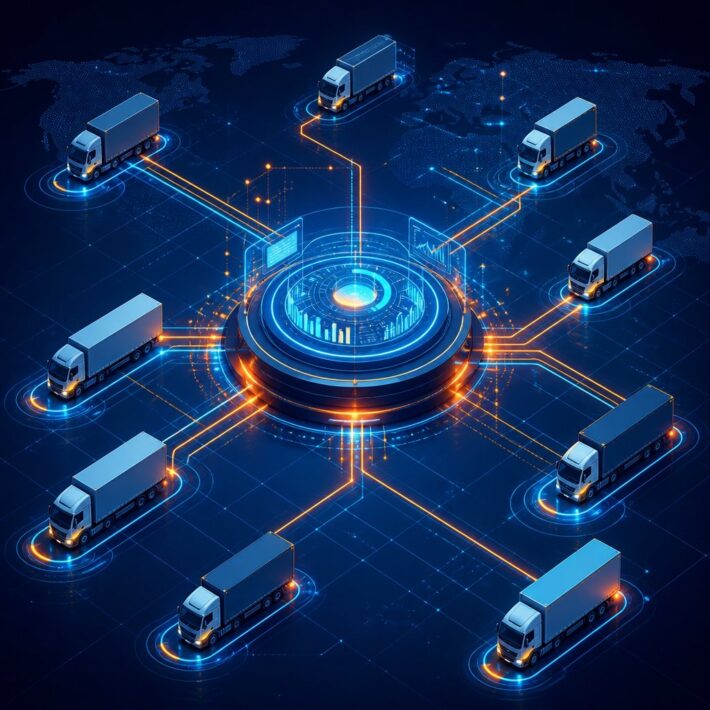
Interface personalization is just one facet of the revolution. Next-generation TMS integrate a complete chain of intelligent features that transform the entire logistics experience.
Real-Time Delivery Tracking
Thanks to driver geolocation and predictive analytics, tracking becomes proactive. The TMS no longer just displays a position: it anticipates delays, proposes alternative solutions, and automatically informs recipients.
Complete Traceability and Compliance
Every event is timestamped, every digital signature preserved, every delivery photo archived. This end-to-end traceability meets the growing demands for proof of delivery, GDPR compliance, and client reporting.
Dynamic Rescheduling
A late driver, an unavailable client, an unexpected traffic jam? AI automatically reschedules routes, simultaneously optimizing cost, time, and carbon footprint. The dispatcher validates, the algorithm executes.
SMS Notifications and Automated Communications
The recipient receives a personalized SMS with a precise delivery window, a map-based tracking link, and the ability to reschedule their appointment themselves. The result: fewer calls to customer service, fewer failed deliveries, greater satisfaction.
Measurable Benefits for Carriers
Companies that have adopted these next-generation TMS see concrete and rapid gains, often visible from the first months of use.
- 40 to 60% reduction in order entry time
- 30% decrease in incoming customer service calls
- Significant drop in data entry errors and billing disputes
- Clear improvement in customer satisfaction (NPS)
- Accelerated onboarding of new clients: a few hours instead of several weeks
Beyond the numbers, operational agility reaches a new dimension. A salesperson signing a new client can now promise a dedicated interface for the following week — and keep that promise.

The Everest of Logistics: Aiming for the Summit of Performance
Adopting an AI-driven TMS is a bit like preparing to climb Mount Everest. The summit — perfectly fluid, personalized, and anticipatory logistics — seems unreachable from base camp. Every company starts with its own equipment: its processes, its teams, its legacy systems.
But unlike Everest, modern technology here plays the role of an experienced sherpa. It marks the path, lightens the load, and transforms what seemed insurmountable into controlled progress. Acclimatization stages become deployment milestones: first order digitization, then tracking, then predictive optimization, until reaching that summit where every delivery becomes a premium experience.
Carriers still hesitating risk letting their competitors plant their flag at the summit before them. And in this market, the view from the top makes all the difference.
How to Choose Your Next-Generation TMS?
Faced with an abundant offering, a few criteria help distinguish real AI solutions from mere marketing hype.
Questions to Ask Your Future Vendor
- Can I modify an interface without code, using natural language?
- How long does it take to deploy a new client?
- Does the system learn from my own data to improve its predictions?
- Are notifications natively multi-channel (SMS, email, WhatsApp)?
- Is rescheduling truly automatic or does it require systematic manual validation?
- Does the vendor offer change management support?
Beware of False Promises
Some vendors dress up classic features as AI. A true intelligent TMS is recognized by its continuous learning capability, its conversational interface, and its total flexibility. Always request a demonstration under real conditions, with your own data.
Conclusion: Logistics Enters a New Era
The AI-driven TMS revolution is neither a fad nor a technological gimmick. It’s a profound transformation that redefines what a transportation company can offer its clients. Rigidity gives way to hyper-personalization, slowness yields to instantaneity, and complexity fades behind the simplicity of a natural language conversation.
For industry leaders, the question is no longer whether to adopt these technologies, but when and with which partner. Those who take the step now will build a lasting competitive advantage: more loyal clients, more efficient teams, and an adaptability that will quickly become the market standard.
Order entry is only the beginning. Tomorrow, the entire logistics chain will speak the language of artificial intelligence fluently.