
RFID, barcode, photo: what level of proof for which type of flow?

The real issue with loading isn’t stock. It’s the transfer of responsibility.
Between the last WMS scan and the first TMS status, there’s a blind spot. A few minutes, sometimes several dozen minutes, during which nobody really knows who holds the parcel. The WMS has removed it from stock, the carrier hasn’t yet taken it into account, and the loading dock becomes a contractual grey zone.
It’s in this gap that the majority of operational disputes arise: unexplained inventory discrepancies, customer credits for parcels “never received”, carrier refusals to take charge, disputes over the waybill. The debate around RFID, barcode or a simple photo is therefore not about reading accuracy. It’s about the quality of the evidence produced at the exact moment responsibility is transferred.
Three levels of proof, three different logics
Before choosing a reader or a technology, you need to clarify what you’re trying to prove, to whom, and at what moment. Each technological building block addresses a specific evidence need.
The photo: proof of condition, not proof of scan
The photo taken at loading (pallet condition, wrapping, seal number, truck registration plate) is the cheapest and often underestimated brick. It doesn’t prove which parcels have been loaded, but it proves in what condition the goods left the dock. It’s descriptive evidence, useful in the event of a transport dispute (breakage, water damage, collapsed pallet on arrival).
Barcode: unit-level proof, but costly in handling
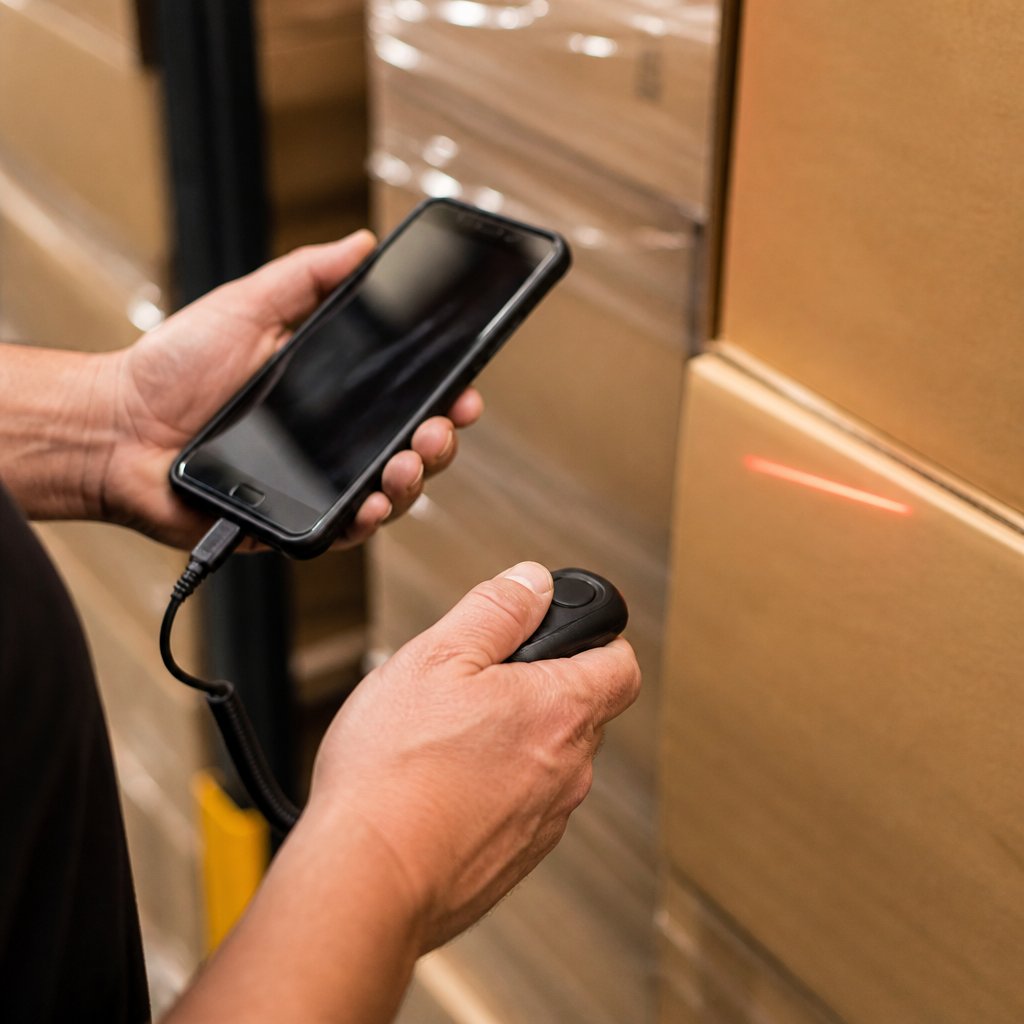
Barcode scanning, whether done with a Zebra TC26 or an Android smartphone equipped with an app, proves that an identified parcel was actually processed at a given time T. It’s the most solid legal evidence at the parcel level. But it has a cost: each parcel must be handled and presented to the reader. On an e-commerce flow of 200 parcels/day, it’s manageable. On a retail cross-dock of 3,000 parcels in two hours, it becomes a bottleneck.
RFID: bulk proof on the fly
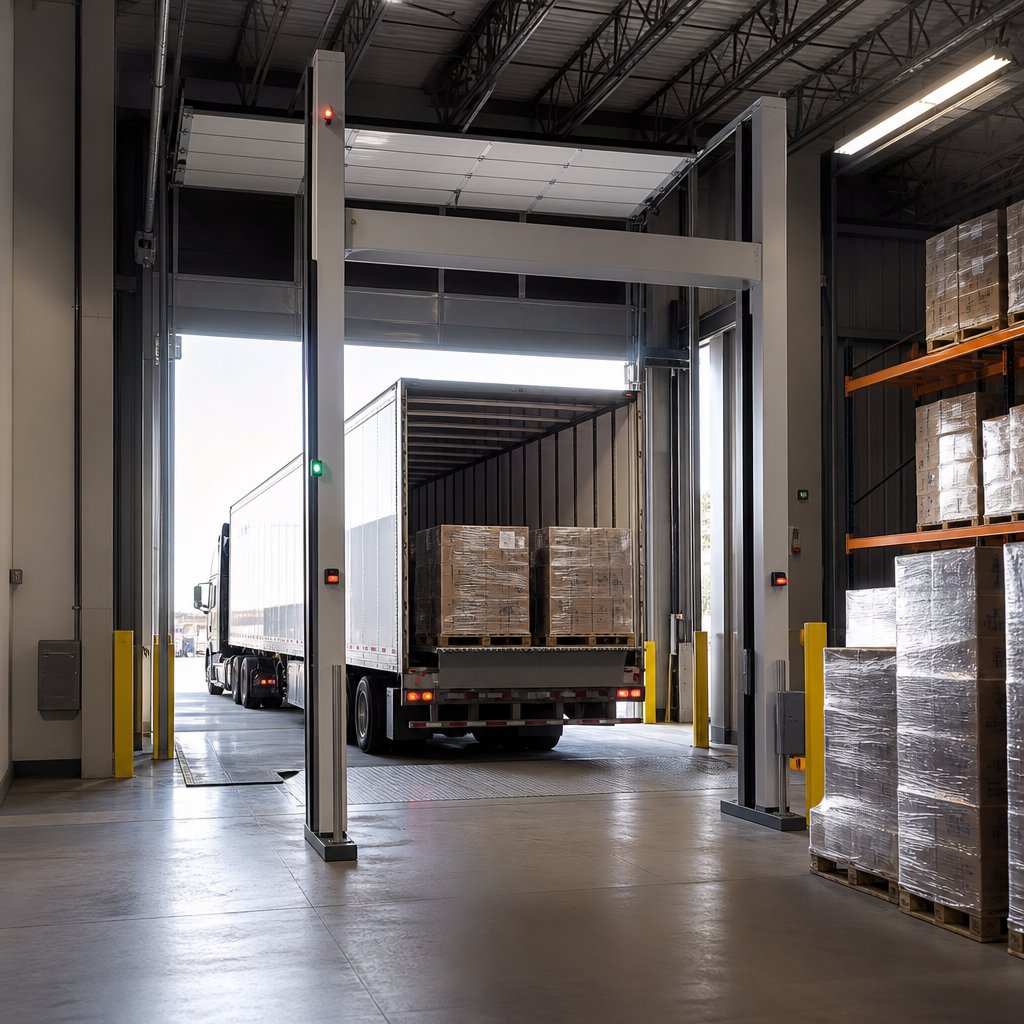
RFID read at the dock gantry turns loading into an automatic event. The 40 parcels on a pallet are identified in one second, without handling, without input errors. For heavy industrial flows, where the truck has to leave in 15 minutes, it’s the only tech that keeps pace without degrading the evidence.
A decision grid by flow type
Not all logistics operations have the same evidence requirements. Over-investing in an RFID gantry when a photo suffices is as costly as installing an €80 reader on a flow that would have justified industrial infrastructure.
B2C e-commerce flows: unit barcode is enough
Moderate volume, unit parcels labelled at source, express carrier scanning at pickup. The point of truth on the shipper side is the last WMS scan, and the point of truth on the carrier side is their own pickup scan. A reader such as the Chafon H103 connected to an Android smartphone does the job perfectly, for an investment of less than €100 per station. Adding RFID here would be over-engineering.
Palletised B2B flows: RFID + photo at loading
Here, the handling unit is the pallet, responsibility shifts when the truck is loaded, and a transport dispute can represent several thousand euros. RFID at the dock gantry lets you certify what has left without slowing down loading, and the photo documents the condition at the moment of transfer. This is the only case where the RFID investment (gantries, tags, integration) is clearly profitable.
Multi-drop retail: traceability must follow the route
On multi-customer routes, proof must be produced at each stop. The on-board barcode reader (Zebra TC26 rugged type or even a driver smartphone with Chafon H103 over Bluetooth) allows scanning at delivery, associating a signature, a photo, a GPS location. Here, in-truck RFID exists but remains rare: ROI is hard to justify against a scan well integrated with the TMS.
Quick recap
- B2C e-commerce: barcode scan at station + overall pallet photo at loading
- Palletised B2B: RFID at gantry + photo + automatic reconciliation of delivery note/waybill
- Retail cross-dock: RFID at dock entry/exit, unit barcode as backup
- Multi-drop: mobile scan at each stop + proof of delivery (photo, signature)
Zebra vs Chafon: the real debate isn’t price
People often pit the industrial Zebra (rugged, standalone, €800 to €1,500) against the Chafon H103 (Bluetooth reader that connects to any Android smartphone, around €50-80). It’s a bad debate if it’s limited to price.
The Zebra makes sense when the device is handled all day by a forklift operator, when it drops, gets dusty, has to last 10 hours on battery and operate in sub-zero cold zones. The Chafon H103 makes sense when scanning is occasional, when the operator already has a smartphone in hand, or when you want to equip 30 drivers without blowing the CAPEX.
The real question is: what does the TMS accept as a data source? A TMS that only accepts its own proprietary terminals locks you into a single hardware category. An open TMS accepts both and lets logistics choose the brick suited to each flow.
The cost of a scan isn’t the price of the reader. It’s the price of the reader, plus the integration cost, plus the cost of data poorly ingested on the TMS side.
What RFID doesn’t solve
Let’s be clear: installing an RFID gantry at the dock doesn’t magically resolve disputes. If the data read is not properly ingested into the TMS, associated with the waybill, timestamped, digitally signed and surfaced in customer tracking, you’ve just moved the problem.
RFID produces a massive data stream. Without an automatic reconciliation mechanism between what has been scanned (WMS), what has been loaded (dock RFID) and what appears on the waybill (TMS), you create three truths that will end up contradicting each other. The dispute doesn’t disappear, it just becomes more documented.
The three conditions for usable evidence
- Consistent timestamps between systems (WMS, gantry, TMS)
- Automatic reconciliation of scanned parcel ↔ waybill line ↔ customer order
- Operator traceability: who scanned, when, at which dock, for which carrier
How Everest TMS approaches the subject
On this specific ground of responsibility transfer, Everest has made a pragmatic choice: not to impose hardware. The TMS equally accepts data feeds from an industrial Zebra, an Android smartphone with a Chafon H103, or a dock RFID gantry. Each event (scan, photo, RFID read) is timestamped, linked to a waybill and automatically reconciled with incoming WMS data.
In practical terms, this allows a multi-flow logistics operator to equip its palletised dock with RFID, its drivers with smartphones plus Bluetooth reader, and its cross-dock with rugged Zebras — all feeding into a single usable chain of evidence. It’s this flexibility that makes the hardware debate secondary: you choose the brick suited to each flow, without being locked into a proprietary ecosystem.
The other benefit, less visible but central, is clean data ingestion: when a dispute surfaces three weeks later, you can find in a few clicks who loaded what, at what time, in which truck, with what photo evidence. The transfer of responsibility once again becomes a documented contractual event, no longer a grey zone.
Conclusion: invest in the boundary, not in the terminal
The right level of proof is not the highest available on the market. It’s the one that matches the value of the flow, the risk of dispute, and the pace constraint. A photo may suffice where an RFID gantry would be wasteful. A unit barcode scan may be ridiculously undersized for a cross-dock handling 3,000 parcels/hour.
What matters isn’t the tech chosen but the continuity of evidence between WMS and TMS. As long as this boundary remains a blind spot, no reader, however expensive, will resolve inventory discrepancies and carrier disputes. The real investment is in integration, not in the terminal.