Transport dispatcher: role, job and TMS software to optimize dispatch
Between endless phone calls, cascading unexpected events, and deadline pressure, a dispatcher‘s daily routine sometimes resembles a tightrope walker’s performance. Yet, they’re the ones who keep the entire delivery operation running. Without an efficient dispatcher, no optimized routes, no satisfied customers, no profitability. But here’s the thing: this nerve center of logistics is cracking under the load. Tools haven’t kept pace with evolving requirements. The result? Extended workdays, constant stress, and processes that still rely too often on Excel and the phone. Fortunately, modern TMS software is revolutionizing this profession by automating repetitive tasks and finally giving dispatchers the means to work with peace of mind. A deep dive into a little-known but essential profession, and above all: how digitalization is radically changing the game.
What Exactly Is a Dispatcher?
The Official Definition (and Real Life)
A dispatcher is the person who plans, organizes, and coordinates all deliveries for a transport or logistics company. Their role? To act as the link between customer orders, available delivery drivers, and operational constraints. On paper, it seems simple. In reality, it’s a juggler’s job. Specifically, the dispatcher must:
- Receive and process incoming orders
- Assign missions to the right drivers based on their skills, zones, and availability
- Build coherent routes to optimize time and distance
- Handle unexpected situations in real-time (delays, breakdowns, absences)
- Communicate with customers, drivers, and internal teams
- Track deliveries until completion
The dispatcher is the conductor who ensures everything arrives at the right place, at the right time.
A High-Pressure Job
The pressure is constant. Every minute counts. A driver stuck in traffic, a customer modifying their time slot at the last minute, an urgent package to insert into an already finalized route… So many situations that transform a well-organized day into an obstacle course. “Before Everest, we spent our time on the phone. It was very time-consuming and a source of errors,” testifies Maité Gallou, founder of Licorne Express. All dispatchers know this reality. And it’s intensifying with the growth of e-commerce and the demand for increasingly rapid deliveries.
Concrete Challenges of Traditional Dispatching
The Phone as the Main Tool
In many transport companies, dispatchers still spend 4 to 6 hours a day on the phone. Calling drivers to transmit missions, calling customers back to confirm time slots, following up with teams for proof of delivery… This operating mode generates three major problems:
- Considerable time waste on low-value-added tasks
- Risk of errors in transmitting verbal information
- Lack of traceability of exchanges and decisions
Issam Chaker, manager of Speedcare Logistics, confirms: “With Everest, we no longer need to be on the phone all day like we used to.”
Manual Assignment That Takes Hours
Manually assigning 50, 100, or 200 daily orders to a fleet of drivers is a constant headache. You have to juggle:
- Each driver’s geographical zones
- Available vehicle types
- Required specific skills (refrigerated, fragile items, etc.)
- Availability schedules
- Delivery deadlines promised to customers
Result? Between 1.5 and 3 hours of work each morning just to distribute missions. Time that could be devoted to improving service quality or developing new customers.
Lack of Real-Time Visibility
Without a connected tracking system, it’s impossible to know precisely where deliveries stand. The dispatcher must:
- Regularly call drivers to check status
- Handle anxious customer calls asking where their package is
- Improvise in the face of delays without reliable ETAs
This lack of visibility generates stress for all stakeholders and degrades the customer experience. 
How TMS Software Revolutionizes the Dispatcher Job
TMS software (Transport Management System) radically transforms dispatchers’ daily routines by automating time-consuming tasks and providing complete visibility over operations.
Automatic Assignment Based on Intelligent Rules
Good TMS software allows you to configure automatic assignment rules based on your own business criteria. For example:
- All deliveries in the 15th district → Driver A
- All orders from customer X → Driver B
- All urgent missions before 10 AM → Drivers with light vehicles
- All deliveries over 30kg → Drivers with utility vehicles
Once these rules are configured, the system automatically assigns missions in seconds. The dispatcher retains control for special cases but saves 1 to 2 hours per day on this task.
Push Notifications That Replace Calls
No more phone calls to notify drivers. With a mobile app connected to the TMS software, each new mission automatically generates a push notification on the relevant driver’s smartphone. They instantly receive:
- The delivery address with optimized route
- Recipient information
- Specific instructions
- Time slot to respect
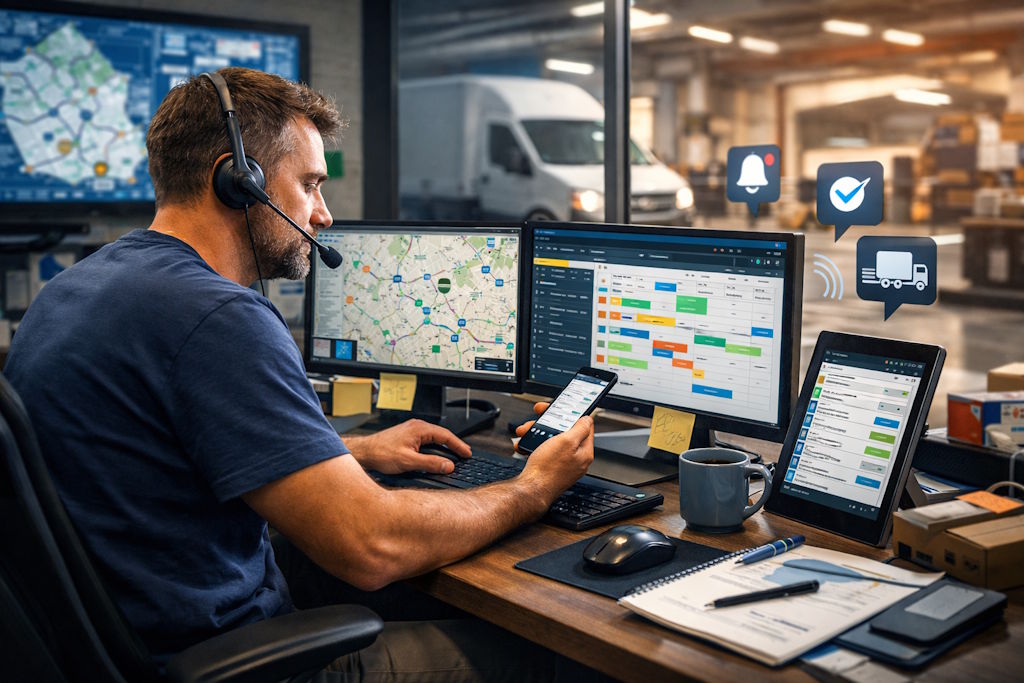
The Dashboard That Provides the Overall View
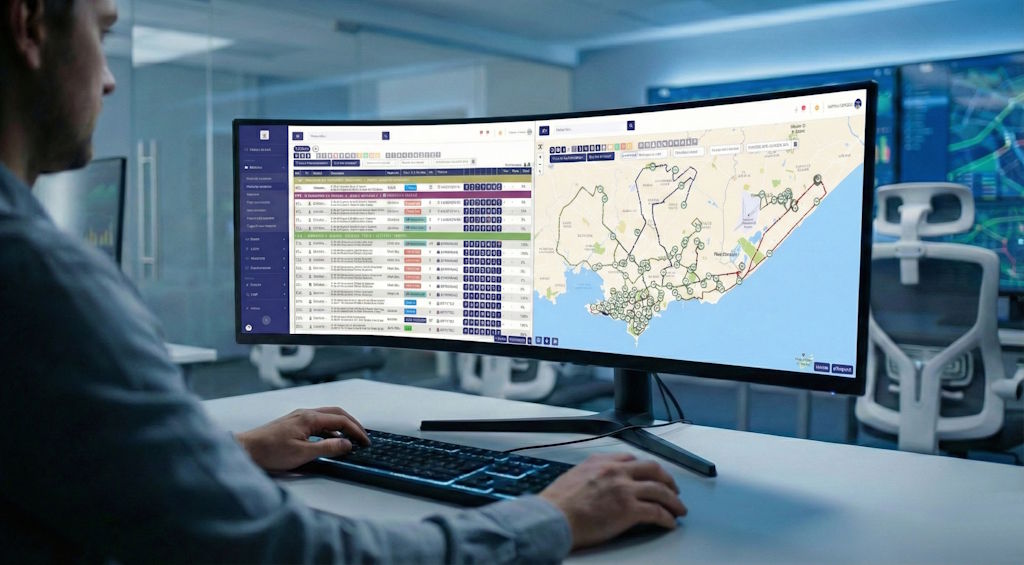
Rather than juggling between Excel, emails, and phone, the dispatcher accesses a single interface that centralizes all information:
- Map view with real-time driver geolocation
- List view with each mission’s status
- Planning view to visualize workload
- Automatic alerts in case of delay risk
Key Features of TMS Software for Dispatching
High-performance TMS software for dispatching must offer several complementary functional components.
Route Optimization
Beyond simple assignment, route optimization creates logical routes that minimize kilometers traveled while respecting constraints (time slots, vehicle capacity, mandatory breaks).
Specifically, TMS software automatically calculates the best route taking into account multiple parameters: real-time traffic density, priority delivery zones, time windows imposed by customers, or specific skills required for certain missions.
The result? Coherent routes that drastically reduce empty kilometers, limit driver fatigue, and improve time slot compliance rates. Some companies see up to 30% fuel savings simply by switching from manual planning to algorithmic optimization.
For the dispatcher, it’s a monumental time gain. What used to take 2 hours of thinking and adjustments now takes just a few clicks. The tool proposes optimized routes that the dispatcher can still manually adjust if necessary, thus maintaining final control over the organization.
Real-Time GPS Tracking
Driver geolocation allows the dispatcher to:
- Verify that a mission is progressing normally
- Calculate dynamic ETAs and warn customers in case of delay
- Quickly reassign an urgent mission to the nearest driver
This transparency transforms unexpected situation management. No more need to call each driver to know where they are.
The dispatcher visualizes in real-time on a map the exact location of each fleet member. If a customer calls to know when their delivery will arrive, the answer is immediate and precise rather than approximate. ETAs automatically recalculate based on actual traffic conditions, allowing anticipation of delays before they even become problematic.
This visibility also changes the relationship with customers. No more anxious calls every 30 minutes. The dispatcher can proactively send status updates or offer real-time tracking links, significantly reducing the load on customer service.
History and Traceability
Every action (assignment, status change, modification) is tracked with timestamp. In case of dispute or to analyze performance, the dispatcher has a complete history accessible in just a few clicks.
This traceability becomes a major asset during customer disputes. No more searching through emails or relying on memory: the system keeps a precise record of who did what, when, and why. If a customer claims never to have received their delivery, the dispatcher can instantly retrieve proof of delivery, the exact time, signature, or photo of the drop-off.
Beyond disputes, this history allows performance analysis over time. Which drivers are fastest? Which zones pose the most problems? Which customers generate the most last-minute modifications? All this data helps the dispatcher continuously improve their organization and make decisions based on facts rather than impressions.
Automated Multi-Channel Communication
The software automatically sends:
- Notifications to drivers upon new assignments
- SMS or emails to customers to inform them of progress
- Internal alerts in case of detected problems
The dispatcher no longer has to manage this communication manually. They can focus on cases that truly require their intervention.
The Profile of the Modern Dispatcher
With TMS software, the profession evolves. The dispatcher is no longer a simple distributor but becomes a strategic pilot of the operation. Their new missions:
- Analyze performance data to identify improvement areas
- Continuously optimize automatic dispatch rules
- Manage relationships with high-value customers
- Train new drivers on digital tools
- Anticipate activity peaks using statistics
This skills upgrade enhances the position and reduces the difficulty associated with repetitive tasks.
Deploying TMS Software: How Long Does It Take?
Companies’ main fear: “it’s going to be long and complicated to implement.” Yet, field feedback shows the opposite. Sébastien de Sousa Lemos recounts: “Everest was very simple to deploy. Within two days, we had the software in hand, we could enter our zones, our rates, deploy it on couriers’ phones. Getting to grips with it was done in no time.” Typical stages of TMS software deployment:
- Initial configuration (1-2 days): setting up zones, rates, service types
- Dispatcher training (2-3 hours): getting to grips with the interface and key features
- Driver deployment (1 day): mobile app installation and field training
- Adjustments (1 week): rule optimization based on initial feedback
In less than 10 days, the entire team is autonomous.
Measurable Gains for the Company
Beyond the dispatcher’s work comfort, digitalization with TMS software generates concrete business impacts. Time savings: Between 1 and 3 hours per day depending on delivery volume Error reduction: 60 to 80% decrease in assignment errors or forgotten missions Improved delivery rate: Fewer failures thanks to better communication and reliable ETAs Fuel savings: 15 to 30% fewer kilometers thanks to route optimization Customer satisfaction: Fewer complaints, more transparency on tracking These benefits quickly translate into positive ROI, often within 3 to 6 months of use.
Pitfalls to Avoid When Choosing TMS Software
Not all TMS solutions are equal. Here are the vigilance points: Unnecessary complexity: Some solutions are so comprehensive that they become difficult to handle. Prioritize ergonomics and simplicity. Lack of flexibility: Your processes are unique. The software must adapt to your way of working, not the other way around. Lack of support: A good vendor trains you and supports you long-term. Avoid “turnkey” solutions delivered without support. Hidden costs: Carefully check what’s included in the pricing (number of users, SMS volume, API access, etc.).
Dispatching and AI: Toward Total Automation?
Artificial intelligence is beginning to integrate into TMS software. Some already offer:
- Assignment suggestions based on learning from past habits
- Delay predictions before they even occur
- Dynamic reoptimization of routes in case of unexpected situations
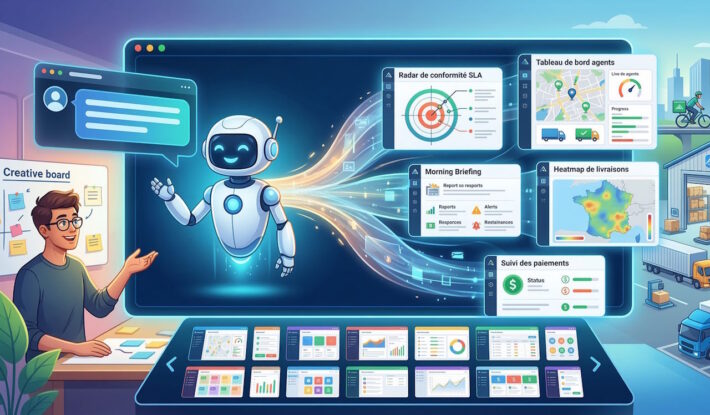
At Everest, our AI assistant Walter helps dispatchers:
- Analyze performance in real-time
- Receive intelligent recommendations to improve efficiency
- Create automatic reports on productivity
The goal is not to replace the dispatcher but to free them from low-value tasks so they can focus on strategy and customer relations.
What Dispatchers Really Appreciate
We interviewed several dispatchers who use TMS software. Here’s what concretely changes their daily routine: “No longer being glued to the phone. Being able to breathe.” “Knowing at a glance where each delivery stands without bothering anyone.” “Having proof of delivery automatically archived and accessible in 10 seconds.” “Being able to go on vacation without everything collapsing, because the processes are in the tool.” “Being proud to show professional tracking to customers, rather than answering ‘I don’t know, I’ll check.'” These small daily details make all the difference over time.
Dispatcher Tomorrow: A Transformed Job, Not a Threatened One
Digitalization doesn’t make the dispatcher profession disappear. It enhances it by eliminating thankless tasks and allowing focus on what makes the real difference: operational intelligence, complex case management, continuous optimization. Companies that equip their dispatchers with modern TMS software quickly observe three effects:
- Less turnover in this stressful position
- Team skills upgrade
- Ability to absorb growth without proportional hiring
In a sector with labor tensions, this is a major competitive advantage. The dispatcher remains the brain that decides. But now, they have a digital nervous system that multiplies their effectiveness tenfold. And that changes everything.
Want to discover how TMS software can transform your dispatchers’ daily routine? Request a personalized demonstration to see the concrete impact on your operations.