Moving Software: How to Reduce Your Last-Mile Costs by 30%?

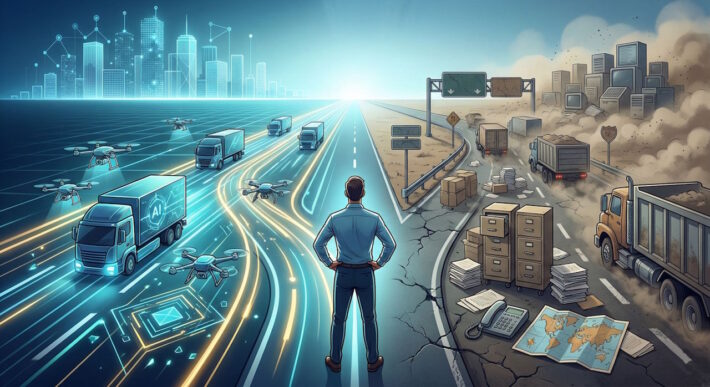
Your drivers are running empty. Your dispatcher spends two hours a day on Excel. Your customers call to know where their package is. Meanwhile, your last-mile costs are exploding: +15% on per-kilometer rates, +2.2% on salaries, +25 to 40% overruns on initial quotes. In 2026, this inefficiency is no longer sustainable. Players who automate their dispatch, track their deliveries, and manage in real-time save 1 to 2 hours per day and reduce their disputes by 75%. You continue to manage manually. This section shows you how modern moving software transforms this hemorrhage into a measurable profitability lever.
Key Takeaways
- Last mile represents 30% of your logistics costs, with overruns of 25 to 40% on quotes
- Automated dispatch saves you 1 to 2 hours per day and reduces assignment errors
- Real-time traceability reduces disputes by 75% and customer service calls by 40%
- Cloud SaaS solutions deploy in 6 to 10 weeks vs 6 to 12 months for on-premise
- Automatic carbon reporting transforms your ecological impact into a measurable commercial argument
Why the Last Mile Concentrates 30% of Your Logistics Costs?
An Economic Burden Exploding in 2026
The last mile represents 30% of your total logistics costs. This already high figure hides a more brutal reality: actual costs exceed initial quotes by 25 to 40%. Manual dispatch, failed delivery attempts, unanticipated disputes: every inefficiency costs you cash.
In 2026, the driver shortage worsens the situation. Personnel costs increase by 2.2%, while per-kilometer rates rise by 15%. Every detour, every empty kilometer becomes a direct additional cost you can no longer absorb.
Low Emission Zones (LEZs) impose additional constraints:
- Mandatory detours that extend routes
- Investments in clean vehicles (electric, cargo bikes)
- Risk of fines for non-compliance
- Complexified urban route planning
The Beaugrenelle Hub in Paris halved its last-mile costs by pooling its urban logistics. You continue dispatching on Excel.
Your Dispatcher Wastes 2 Hours Per Day
Your dispatchers spend 2 hours daily manually assigning deliveries. They juggle between multiple tools: phone, spreadsheet, GPS, messaging. Result: assignment errors, unanticipated delays, misdirected drivers.
Without automation, it’s impossible to simultaneously account for real-time geolocation, driver skills, time constraints, and customer priorities. You assign by gut feeling. Your competitors optimize by algorithm.
This wasted time creates no value. It prevents your teams from focusing on strategic customers or absorbing more volumes. Every hour saved in dispatch frees up measurable operational capacity.
Without Traceability, Your Disputes Explode
Your customer service is drowning in “where is my package?” calls. These inquiries represent 40% of customer contacts. Each call mobilizes a team member, delays urgent case processing, and degrades your professional image.
Without digital proof of delivery, disputes accumulate. No photo, no timestamped signature, no GPS: your word against the customer’s. Disputes slow down your collections and mobilize your legal teams.
Traceability is no longer a technological luxury. It’s the minimum expected by your customers in 2026. Your competitors send automatic notifications at every step. You manually call back to reassure.
What is Modern Moving Software in 2026?
You manage your routes on Excel. Your drivers receive their deliveries by phone. Your customers call to know where their package is. This operating mode costs your dispatcher 2 hours per day and generates disputes you can’t trace. A TMS (Transport Management System) replaces this manual chain with unified automated management.
A Platform That Centralizes Planning, Dispatch, and Real-Time Tracking
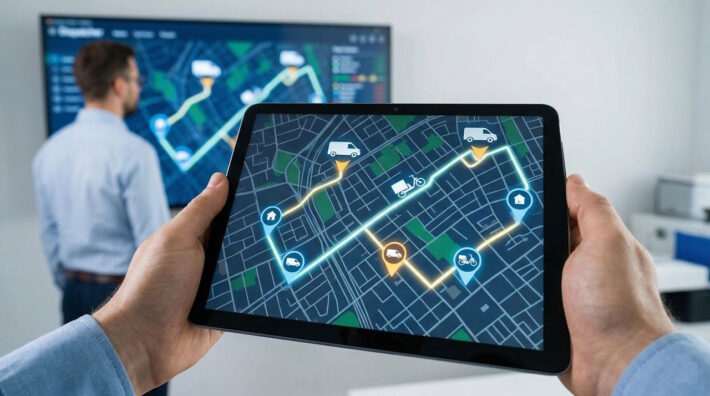
A last-mile TMS centralizes all your delivery operations on a single interface. You plan your routes, automatically assign deliveries based on geolocation and driver availability, and track each delivery in real-time. Your drivers receive their deliveries on a mobile app with optimized routes. Your customers receive automatic notifications at every step.
63% of the TMS market already operates in cloud mode in 2024, with growth of 14.92% per year (Mordor Intelligence). This SaaS architecture allows deployment in a few days, without heavy IT infrastructure or massive initial investment.
What Differentiates a TMS from Excel: Decision Automation
Excel makes no decisions. You manually assign each delivery, call drivers, manage unforeseen events in real-time. Moving software automates these decisions:
- Multi-criteria route optimization algorithm
- Intelligent dispatch based on time constraints
- Vehicle capacity consideration
- Automatic reassignment in case of delay or unforeseen event
- Proactive customer alerts
Modern TMS platforms ingest traffic, weather, and carrier capacity data every few minutes to dynamically redirect drivers and automate customer alerts. You move from static planning to dynamic planning.
White Label: Your Customers See YOUR Brand, Not a Provider’s
A white-label TMS displays your visual identity across the entire customer chain: SMS/email notifications, tracking page, feedback form. Your customer never sees a third-party provider’s name. They associate tracking quality with your professionalism.
This complete traceability reduces disputes by 75% and customer service calls by 40% (Everest, 2026). Each delivery generates timestamped digital proof: photo, signature, geolocation. You close disputes in 30 seconds, not 3 days of investigation.
How Automated Dispatch Saves You 1 to 2 Hours Per Day?
You still spend two hours a day dispatching on Excel? Juggling driver availability, customer constraints, and last-minute unforeseen events? This time creates no value. It prevents you from processing more volumes and saturates your teams.
The Real Cost of Manual Dispatch in 2026
A dispatcher spends an average of 2 hours per day on tasks with no added value:
- Manually assigning deliveries one by one
- Calling drivers back to confirm their availability
- Managing unexpected delays in real-time
- Correcting assignment errors
- Juggling between multiple unconnected tools
This time represents 25% of a workday lost to pure administrative logistics.
Assignment errors cost even more. A driver sent to the wrong place, a delivery assigned to an unsuitable vehicle, an unmet customer time slot: each error generates a return, an unhappy customer, a delivery to redo. Without an optimization algorithm, you’re flying blind. You waste time and money.
The Optimization Algorithm: Automatic Assignment in Seconds
An automated dispatch assigns orders based on three simultaneous criteria: driver availability, real-time geolocation, job skills, and customer time constraints. The algorithm calculates in seconds what takes a dispatcher 20 minutes to do manually. It integrates unforeseen events (delay, breakdown, cancellation) and instantly reassigns deliveries without human intervention.
Measured result at Eagles Courses: gain of 1 to 2 hours per day on the dispatch step from the first week of deployment. This freed time allows processing 30% additional volumes with the same team or focusing on strategic customer relations.
Fewer Errors = Fewer Disputes, More Profitability
Automated dispatch drastically reduces assignment errors. Each delivery is assigned to the right driver, with the right vehicle, at the right time. Fewer returns. Fewer unhappy customers. Fewer deliveries to redo. AI verification of proof of delivery (POD) reduces by 85% the time between delivery and invoice sending, accelerating your collections.
This productivity gain is not theoretical. It’s measurable from the first weeks. You save time on dispatch. You reduce errors. You process more volumes without hiring. Your team focuses on what creates value: customer satisfaction and business growth.
Transport Traceability: How to Reduce Disputes by 75%?
Your customers are calling. Your customer service is saturated. “Where is my package?” represents 40% of incoming calls. Each call mobilizes a team member for 5 to 10 minutes. This time creates no value. It costs. And it degrades the professional image you want to project.
Real-time traceability reverses this equation. It transforms uncertainty into visibility. It reduces disputes by 75% and customer service calls by 40%, according to Everest 2026 field data. Except you need to understand what differentiates real traceability from simple GPS.
Driver GPS + Automatic Notifications = End of “Where Is My Package?” Calls
Geolocation alone is not enough. You know where the driver is, but your customer knows nothing. They wait. They worry. They call.
Effective traceability combines three components:
- Real-time GPS: driver position updated every 30 seconds
- Automatic notifications: “Your delivery arrives in 15 minutes”, “Your package is delivered”
- White label: the customer receives these messages in YOUR name, not an external provider’s
This architecture transforms anxiety into confidence. The customer no longer tries to reach you. They track. You save 1 to 2 hours per day of customer service time. Your teams focus on value-added tasks.
Digital POD: Proof of Delivery That Accelerates Your Payments
“I never received this package.” This sentence triggers a time-consuming verification cycle: call to the driver, search for the right paper, illegible scan, dragging dispute. Result: payment delay, unhappy customer, commercial tension.
Digital POD (Proof of Delivery) eliminates this risk. At each delivery, the driver captures:
- A geolocated photo of the delivered package
- A timestamped electronic signature
- A comment if needed (delivered to neighbor, access code used)
These elements are automatically stored and accessible with one click. You prove delivery in 10 seconds. Disputes disappear. Billing cycles accelerate. Some AI solutions, like Podchecker.ai, even automatically analyze these PODs with 99% accuracy to detect anomalies before they become disputes.
“Digital proof of delivery is not a technological gadget. It’s the legal shield that protects your cash flow and accelerates your collections by 85%.”
White Label: Your Professional Image, Not a Third Party’s
You deliver. But it’s an external provider’s name that appears in customer notifications. Your brand fades. The customer doesn’t associate you with the quality of service they receive.
White-label traceability reverses this logic. Every notification, every tracking page, every post-delivery feedback bears YOUR visual identity. The customer sees your logo. They remember your professionalism. You capitalize on the delivery experience to strengthen your positioning.
This total control over customer experience is not cosmetic. It conditions loyalty. A customer who receives transparent tracking, in your name, comes back. A customer who suffers a third party’s opacity seeks an alternative.
Decarbonized Delivery: How to Transform Your Ecological Impact into a Commercial Argument?
You Deliver by Cargo Bike, But Nobody Knows It
You’ve invested in a fleet of electric bikes. You avoid LEZs. You reduce your emissions. But your customers don’t see it. Result: your ecological effort remains invisible, your differentiation nonexistent.
The last mile represents 25% of urban CO2 emissions. Low Emission Zones are multiplying. B2B customers increasingly integrate environmental criteria into their tenders. Decarbonization is no longer an option, it’s a regulatory AND commercial issue.
Automatic Carbon Reporting: Proving What You Do
Modern moving software automatically calculates the carbon footprint of each delivery. Per route. Per customer. Per mode of transport. Bike, electric, thermal: every kilometer traveled generates exploitable data.
| Mode of Transport | CO2 Emissions/km | Reduction vs Diesel |
|---|---|---|
| Cargo bike | 0.02 kg | -92% |
| Electric vehicle | 0.05 kg | -75% |
| Diesel vehicle | 0.25 kg | Reference |
Cycle logistics reduces 92% of CO2 emissions compared to light commercial vehicles, according to the Sustainable Urban Logistics Mission Report 2025. But without automatic reporting, this performance remains an unmeasured promise.
We’ve seen the Colisactiv’ case in Bordeaux: 720,000 packages delivered by cargo bikes in 2024, avoiding nearly 2.4 million km in light commercial vehicles. Each package generates an average environmental premium of €0.27, representing 7.2% of revenue.
Transforming Ecological Impact into Commercial Differentiation
Your customers receive a notification: “Your delivery saved 3.2 kg of CO2 vs a diesel delivery.” This message is not greenwashing. It’s measured, traceable, verifiable data.
Rexel integrated this carbon reporting into its delivery process. Result: measured reduction in CO2 emissions, communicated to end customers. Ecological impact becomes a concrete commercial argument, not a statement of intent.
B2B customers who must themselves account for their carbon footprint (scope 3 carbon assessment) value this transparency. You no longer just deliver a product. You deliver measurable proof of environmental commitment. This advantage builds loyalty, differentiates, and justifies a price premium.
How to Choose Your Moving Software in 2026?
You’ve identified the problem. You know what a TMS can do. It remains to choose the right platform. Not the one that promises the most, the one that delivers measurable results from the first week.
Deployment Speed: Cloud SaaS or On-Premise?
You don’t have six months to waste. A cloud SaaS solution deploys in 6 to 10 weeks maximum. An on-premise architecture? Count 6 to 12 months, with IT infrastructure costs that explode before the first automated dispatch.
94% of global companies already use cloud computing. For transport and retail SMEs, it’s a strategic choice:
- No servers to manage
- Automatic updates without interruption
- Instant multi-site access
- Predictable costs (monthly subscription)
- Immediate scalability
European mid-market companies that switched to cloud solutions reduced their costs by more than 25% in the first year.
At Minute Pharma, Everest deployment took a few days. Immediate result: complete traceability and real-time tracking to reassure patients. No endless testing phase, no multi-month IT tunnel.
API Integration: Your TMS Must Speak to Your Ecosystem
Your e-commerce runs on Shopify. Your ERP is on Sage. Your stores use a proprietary POS. If your moving software doesn’t natively integrate with these tools, you create a new silo. You waste time re-entering, exporting, manually synchronizing.
A modern platform exposes open REST APIs. It automatically retrieves orders, sends delivery statuses, updates inventory in real-time. No double entry, no lag between your systems.
Rexel connected Everest to its existing ecosystem. Interconnection with carriers, centralized delivery administration, and automatic customer notifications transformed the delivery experience to 2-hour delivery with real-time tracking.
White Label: Your Image, Not a Provider’s
Your customers receive a tracking SMS signed “LogisticPro” when they ordered from you. You lose an opportunity to strengthen your brand. Worse: you delegate the final customer relationship to a third party.
A complete white-label platform displays YOUR logo on tracking, YOUR name in notifications, YOUR graphic charter on the feedback page. The customer only sees you. You control the experience end-to-end.
Brigitte Dumont manages all her platforms from Everest: “I can check activity and delivery status at any time, in two clicks.” But above all, her customers only see the Brigitte Dumont brand, never that of an external provider.
Scalability: Same Tool from 8 Couriers to 80 Stores
You manage 8 couriers today. In 18 months, you’re targeting 30 vehicles and 5 regional platforms. If your TMS doesn’t scale, you’ll have to migrate during growth. Data loss, team retraining, hidden costs.
A scalable platform manages 8 couriers or 80 stores with the same interface, the same business logic, the same automations. No version change, no additional cost per volume tier.
Diligo went from 1 to 21 cargo bikes in 2 years with Everest. Same tool, same unified management, no technological disruption.
Key Takeaways
- Cloud SaaS solutions: deployment in 6-10 weeks vs 6-12 months for on-premise
- Open APIs mandatory to avoid data silos
- Native white label to control customer experience
- Proven scalability from 8 to 80+ vehicles without migration
- Measurable ROI from the first weeks with concrete KPIs
Measurable ROI: Concrete KPIs, Not Vague Promises
“Improved operational efficiency” means nothing. You need numbers: how many hours saved per dispatcher? How many fewer disputes? How many customer service calls avoided?
A serious platform displays measurable KPIs from the first weeks: 40% reduction in “where is my package?” calls, 75% decrease in disputes, 1 to 2 hours per day gained per dispatcher. These gains are documented, verifiable, reproducible.
You’re not looking for a tool that promises. You’re looking for a tool that delivers. In 2026, prioritize cloud/SaaS solutions with open APIs, native white label, and proven scalability. The rest is PowerPoint slides.
Taking Action
The last mile concentrates 30% of your logistics costs. Manual dispatch costs you 2 hours per day. Disputes explode due to lack of traceability. These inefficiencies are no longer sustainable in 2026. Modern moving software automates dispatch, tracks each delivery in real-time, and transforms your ecological impact into a measurable commercial argument. The gains are immediate: 1 to 2 hours saved per day, 75% fewer disputes, 40% fewer customer service calls.
The question is not whether you should digitize, but when. Your competitors are already managing by algorithm. They track. They scale. Everest supports last-mile players who want to move from manual management to unified control. Cloud SaaS, open APIs, native white label: a platform that delivers measurable results from the first week.
FAQ
What is the Difference Between a TMS and Route Management Software?
Route management software only optimizes routes. A TMS (Transport Management System) covers the entire cycle: planning, automated dispatch, real-time tracking, digital POD, billing, and reporting. It centralizes all your delivery operations on a single platform.
How Long Does It Take to Deploy a Cloud TMS?
A cloud SaaS solution deploys in 6 to 10 weeks maximum, versus 6 to 12 months for an on-premise architecture. At Minute Pharma, Everest deployment took a few days with immediate complete traceability.
Can a TMS Integrate with My Existing E-Commerce and ERP?
Yes, if the TMS exposes open REST APIs. A modern platform automatically retrieves orders from Shopify, WooCommerce, or your ERP (Sage, SAP), sends delivery statuses in real-time, and updates inventory without double entry.
How to Measure the ROI of Moving Software?
Measurable KPIs from the first weeks: gain of 1 to 2 hours per day per dispatcher, 40% reduction in “where is my package?” calls, 75% decrease in disputes, 85% acceleration of the delivery-billing cycle. These gains are documented and verifiable.
Is White Label Really Important?
Yes. Your customers associate tracking quality with your professionalism, not that of an external provider. A white-label platform displays YOUR logo on tracking, YOUR name in notifications, YOUR graphic charter on the feedback page. You control the customer experience end-to-end.