What Your TMS Should Be Doing in 2026

The transport software market is splitting in two. On one side, tools that do what they’re told. On the other, platforms that anticipate, adapt, and multiply the productivity of everyone who uses them. The dividing line is already here, and it’s widening fast.
What exactly is a TMS supposed to be now?
For a long time, a TMS checked three boxes: create jobs, track deliveries, issue invoices. That was enough. Carriers who adopted one were already ahead of those still working off Excel spreadsheets and phone calls.
That era is over.
In 2026, a TMS that simply does what it’s told is no longer a competitive advantage, it’s an overhead cost. End customers expect real-time tracking, personalised notifications, a delivery experience on par with what industry giants provide. Field teams want a smooth mobile app. Management wants actionable KPIs and billing that doesn’t tie up three people for two days every month.
The real question to ask when evaluating your tool today is no longer “does it handle my deliveries?” It’s “does it let me do more with the same resources?”
What your TMS should already be doing, and most aren’t
Eliminating repetitive tasks to free up your operators
Every minute a dispatcher spends re-entering an order received by email, copy-pasting a status between two tools, or manually chasing a customer about their delivery, that’s a minute not spent on anything that actually matters. And those minutes add up: without measuring it, an operations team can spend 30 to 40% of its time on tasks that could be entirely eliminated.
Automating repetitive processes is no longer an advanced feature. It’s what separates teams that are overwhelmed by their workload from those who control it.
A high-performing TMS in 2026 allows you to build workflows that run themselves: automatic order intake from any source, dispatch rules applied without human intervention, customer notifications triggered by every status change, delivery documents generated at mission close. No development, no IT tickets, rules that operators configure once and that run smoothly from then on.
What this concretely changes for teams: less noise, fewer data entry errors, fewer low-value interruptions. And the ability to absorb volume growth without hiring.
Integrating AI, and not just as decoration
Artificial intelligence is no longer a promise. It’s an operational reality that has firmly embedded itself in logistics over the past two years. According to Capgemini, the percentage of companies using generative AI jumped from 6% in 2023 to 30% in 2025. France Logistique published a dedicated AI guide for the transport and logistics sector in March 2026, a sign that the topic has moved from the realm of technology watch to one of immediate competitiveness.
2026 marks a turning point: AI will no longer be a complementary tool in transport, but a strategic link in the value chain, with direct effects on productivity, resilience and operational speed.
The problem is that AI in a TMS often takes the form of a chatbot in a sidebar that answers basic questions. That’s not integrated AI, it’s cosmetic AI. The artificial intelligence that creates real operational value is the kind that embeds itself into business processes without the operator having to go looking for it.
Concretely, what does that look like?
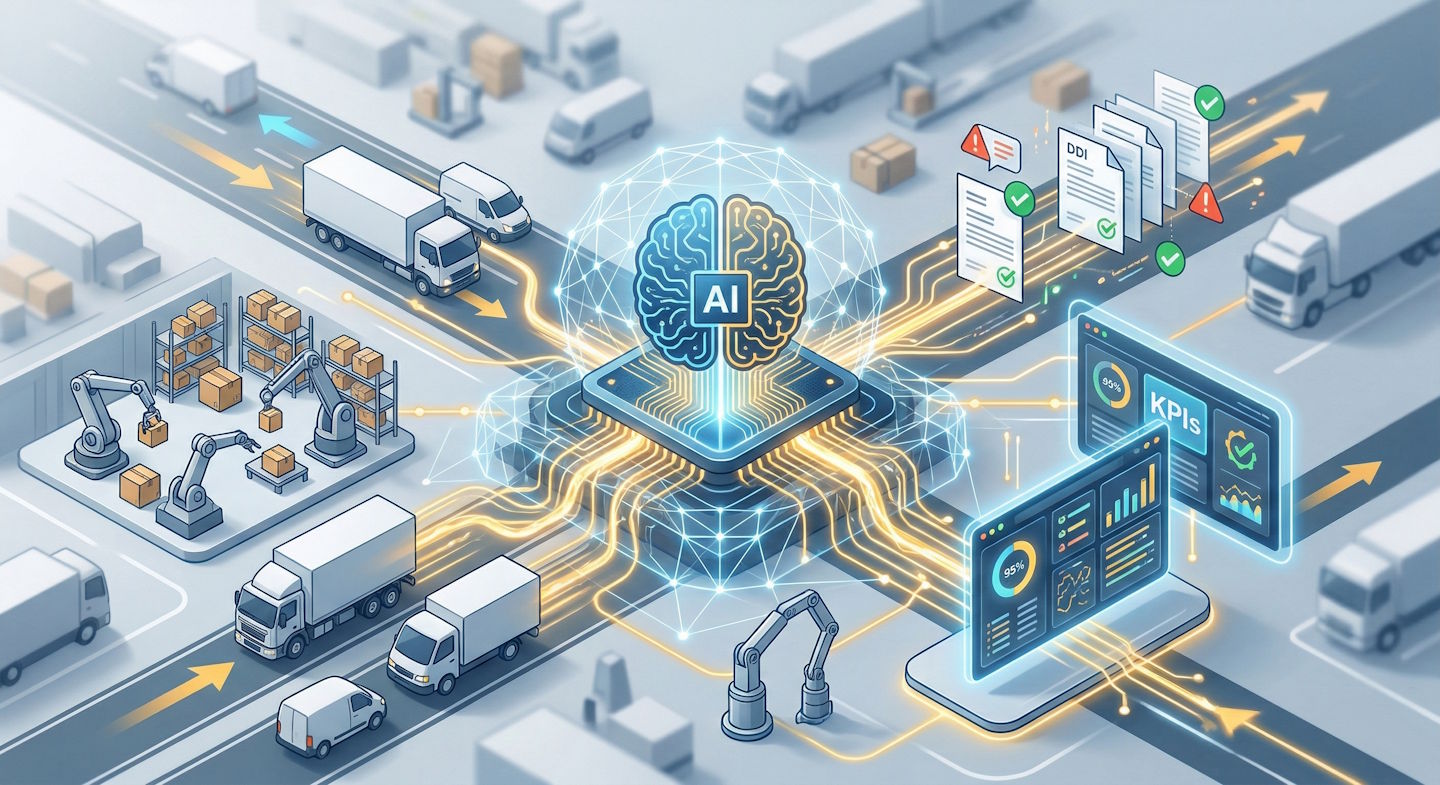
- Automated proof of delivery verification. Thousands of PODs analysed in seconds, signatures, photos, package condition, with anomalies flagged before they become disputes. What used to take 4 to 5 minutes per document now happens instantly, with greater reliability than the human eye. McKinsey estimates that companies applying AI to their operational processes reduce planning errors by 20 to 50%.
- Real-time recommendations. Delay anticipation, optimisation suggestions, proactive alerts — AI should act as an operational co-pilot, not a passive reporting tool.
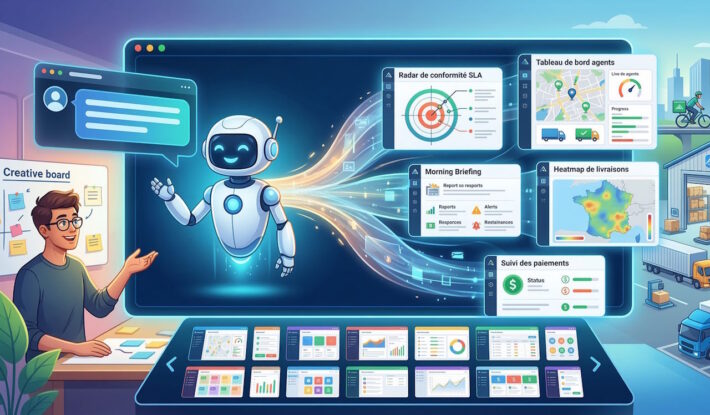
- On-demand custom interfaces. Every client’s needs are different. A solid TMS in 2026 should make it possible to create purpose-built business applications, order forms, tracking interfaces, client dashboards, in minutes, without going through a development team.
AI doesn’t replace your TMS. It makes your TMS useful where it was previously silent.
Adapting to each client, not the other way around
This is one of the most frustrating limitations of traditional TMS platforms: they impose their own logic. You have a client with an unusual pricing structure, a particular workflow, a specific tracking requirement, and you end up spending hours working around the constraints of your own tool.
In 2026, that logic needs to be reversed.
Your TMS should be able to adapt to any business context, without custom development, without a ticket sitting open for three weeks. That means an open, documented API, flexible pricing grids, full white-label capability, and the ability to build custom interfaces for each client or branch.
A carrier that can offer each of its clients a tailored experience, with their own domain name, their brand colours, their notification templates, isn’t just selling delivery anymore. They’re selling a platform. And that fundamentally changes the commercial conversation.
Giving visibility, to you and to your clients
Real-time tracking is a commodity now. What sets the best operators apart is the ability to anticipate rather than react.
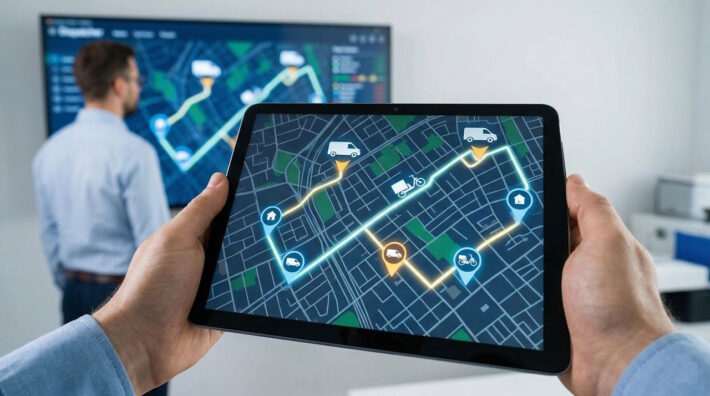
Dynamic ETAs that recalculate based on traffic, automatic alerts when a delay risk is detected, a branded tracking link sent at the right moment, all of this should run without manual intervention. On the internal side, an interactive dashboard with genuinely actionable KPIs (delivery success rate, performance by driver, billing discrepancies, CO₂ emissions) should make decisions possible in seconds, not after an Excel export.
“Everest gives me a complete view of all my platforms’ activity in two clicks. I can switch between platforms and check deliveries at any time.”
Closing the loop without friction, from delivery to invoice
A TMS that manages jobs well but leaves billing outside its scope creates an invisible problem: the operational value produced in the field doesn’t convert into cash flow on time. Unmatched PODs, undetected pricing discrepancies, subcontractor pre-billing handled manually, every friction point here means delay and risk.
In 2026, a serious TMS needs to close this loop end to end: proof of delivery verification directly linked to billing, automatic application of pricing grids, document generation without re-entry. Not to replace the accountant, but to make sure that what was delivered gets invoiced quickly, and without dispute.

The real question to ask about your current tool
It’s not “does my TMS do all of this?”
It’s: which direction is it heading?
A platform that stopped evolving two years ago will be even further behind in two years’ time. Conversely, a tool that progressively integrates automation, AI and personalisation becomes harder to replace every month, and harder to compete against.
Carriers, retailers and cargo cyclists who equip themselves with the right tools today aren’t just trying to manage their deliveries. They’re building an operational infrastructure that will let them grow without hiring, retain clients without competing on price, and adapt to markets that move fast.
This isn’t a question of budget. It’s a question of trajectory.