
TMS Transport Morocco: Why Digitize Your Deliveries in 2026
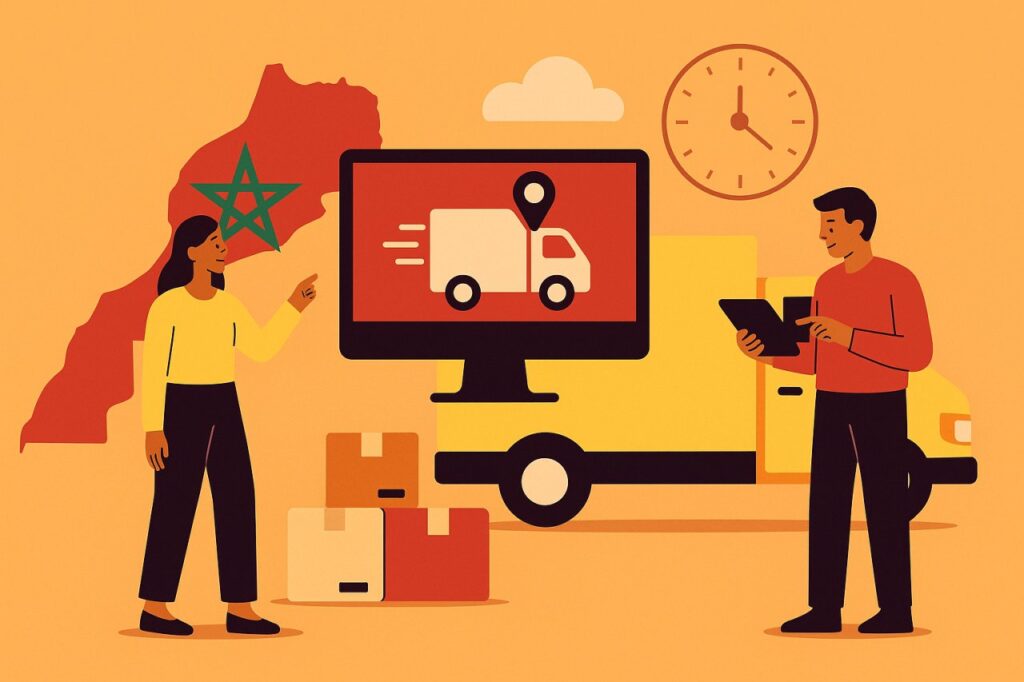
Your volumes are exploding, your customers demand real-time updates, and your competitors are investing in management platforms. Meanwhile, you’re still dispatching on Excel and discovering delays when the phone rings. This operational friction is costly: two hours lost each day, 40% avoidable customer service calls, disputes dragging on due to lack of digital proof. A TMS transport adapted to the Moroccan last mile transforms these pain points into measurable gains: automated dispatch, white-label tracking, carbon traceability. You finally manage with visibility, not with sticky notes.
Key Takeaways
- The Moroccan transport sector grew by 3.9% in 2025, with 95.6 million tons handled (+5.7%): managing this growth without a TMS saturates your teams.
- A TMS reduces customer calls by 40%, frees up 2h/day of manual dispatch, and cuts disputes by 75% through digital POD.
- Choose a scalable, white-label TMS with native APIs and local support: the difference between a tool that grows with you and an operational bottleneck.
- TMS-driven cyclo-logistics becomes a measurable commercial advantage: automatic CO₂ reporting, bike route optimization, quantified CSR argument.
Why the Moroccan transport sector requires a TMS in 2026
The Moroccan transport and warehousing sector recorded an average growth of 3.9% over the first three quarters of 2025 (source: Kaweru/DEPF). This momentum reflects an operational reality: your volumes are increasing, your customers demand more responsiveness, and your competitors are investing heavily in logistics digitalization. Managing this growth with manual tools is no longer sustainable.
95.6 million tons saturating your manual processes
95.6 million tons transited through Moroccan ports in 2025, a +5.7% increase compared to 2024. These growing volumes require seamless coordination between shippers, carriers, and final recipients. Without a centralized management system, you multiply phone calls, assignment errors, and unanticipated delays. We’ve often seen clients discover that a simple seasonal peak is enough to break an Excel system—three days of Black Friday and you spend your nights recalibrating routes.
The Moroccan logistics market, valued at $22.59 million USD in 2025, shows a compound annual growth rate of 6.11% through 2033 (source: DataInsights Market). This expansion is driven by automotive and manufacturing, sectors where real-time traceability becomes a contractual prerequisite. Renault Morocco, for example, already integrates digital twins and predictive maintenance at its Tangier site producing 400,000 vehicles/year—proof that logistics digitalization is no longer reserved for giants.
Your competitors are digitalizing: the cost of inaction
The SNTL is investing 260 million dirhams in its modernization, including a digital fleet management platform with e-vignette (source: Le360). This signal is clear: public and private players are betting on digital tools to gain efficiency and capture growth. Except that only 40% of Moroccan SMEs have migrated to the cloud, hindered by talent shortages and security concerns (source: Mordor Intelligence). This divide creates a risk: staying on Excel means leaving the field to equipped competitors.
Without a TMS, you’re flying blind
Concretely, managing without transport management software means:
- No real-time visibility: you discover delays when the customer calls
- Manual dispatch prone to errors: manual assignments, duplicates, omissions
- Customers calling: “Where is my package?” saturates your customer service—40% of these calls disappear with automated tracking
- Opaque costs: impossible to measure profitability per route, per customer, or per zone
TMS transport: what it really is and what it’s for
A TMS (Transport Management System) is transport management software that centralizes all your logistics operations: planning, execution, tracking, and billing. Concretely, it replaces your Excel files, phone calls, and handwritten notes with a single platform that manages each delivery end-to-end. You gain visibility, control, and responsiveness.
The five building blocks that truly change daily operations
An operational TMS includes five essential functions:
- Route optimization: automatically calculates the most efficient routes considering traffic, time windows, and vehicle capacity
- Automated dispatch: assigns each order to the right driver without manual intervention
- Mobile driver interface: transforms each smartphone into a business tool with digital route sheet, GPS navigation, and electronic signature for POD
- Real-time tracking: geolocation that lets you know where each package is at any moment
- KPI reporting: measures your performance (on-time delivery rate, cost per package, CO₂ emissions)
Rexel deployed this approach to deliver in 2 hours with real-time tracking: “Everest brought us interconnection with carriers, the ability to manage each delivery, and finally notifications for our customers through which we have exceptional customer experience quality.” Result? Fewer customer calls, reduced emissions, strengthened professional image.
Generic TMS vs last-mile platform: a difference in focus
| Criteria | Traditional TMS | Last-mile platform |
|---|---|---|
| Focus | Long-distance transport, freight | Final urban delivery, cyclo-logistics |
| Target | Inter-warehouse flows, mass shipments | Omnichannel retailers, e-commerce, couriers |
| Tracking | Generic carrier tracking | Personalized white-label tracking |
| Driver interface | Adapted to trucks | Optimized for bike/motorcycle couriers, multi-depot |
| Impact measurement | Transport costs | Final customer experience, reduced customer service calls |
Decoding technical jargon without wasting time
Three terms come up often. An API (Application Programming Interface) is a connection between systems: it allows your TMS to automatically communicate with your online store, your ERP, or your partner carriers. No more manually re-entering each order. Real-time geolocation uses smartphone GPS to display the exact position of your drivers on a map. You anticipate delays, inform your customers, and reassign an urgent delivery with one click. Digital POD replaces paper delivery notes with an electronic signature captured on mobile, with photo and timestamp. You have instant proof, automatically archived, that reduces disputes by 75%.
The TMS market is expected to reach $2.27 billion USD in 2025 and grow at a CAGR of 8.92% to reach $3 billion USD, driven by cloud adoption (63% share in 2024) and road freight (58% of revenue), a key sector for last-mile and e-commerce. Players like Omniful are improving their cloud TMS for e-commerce execution with fleet management and live tracking, optimizing urban deliveries. For SMEs in emerging markets like Morocco, modular cloud TMS via API-first microservices generate savings of 10 to 30% on transport costs through route optimization, load factor, and carrier selection.
Measurable gains of a TMS software for carriers and retailers
You spend two hours a day dispatching manually? Your customers call to find out where their package is? These symptoms are costly. A well-deployed TMS transforms these daily irritants into quantifiable gains from the first weeks.
Fewer customer calls, more satisfaction
Without real-time tracking, your customer service is saturated. “Where is my package?” calls monopolize your teams and degrade customer experience. Real-time tracking reduces these requests by 40% (Everest source). Your customers check their tracking link. Your teams focus on real emergencies.
Two-hour delivery, real-time tracking, reduced CO₂ emissions: the TMS structures the entire chain.
Automated dispatch: two hours saved every day
Excel doesn’t scale. Each new route adds complexity. Automated dispatch frees up at least two hours per day and reduces assignment errors by over 60%. The system assigns the right driver, at the right time, to the right zone. You validate. That’s it.
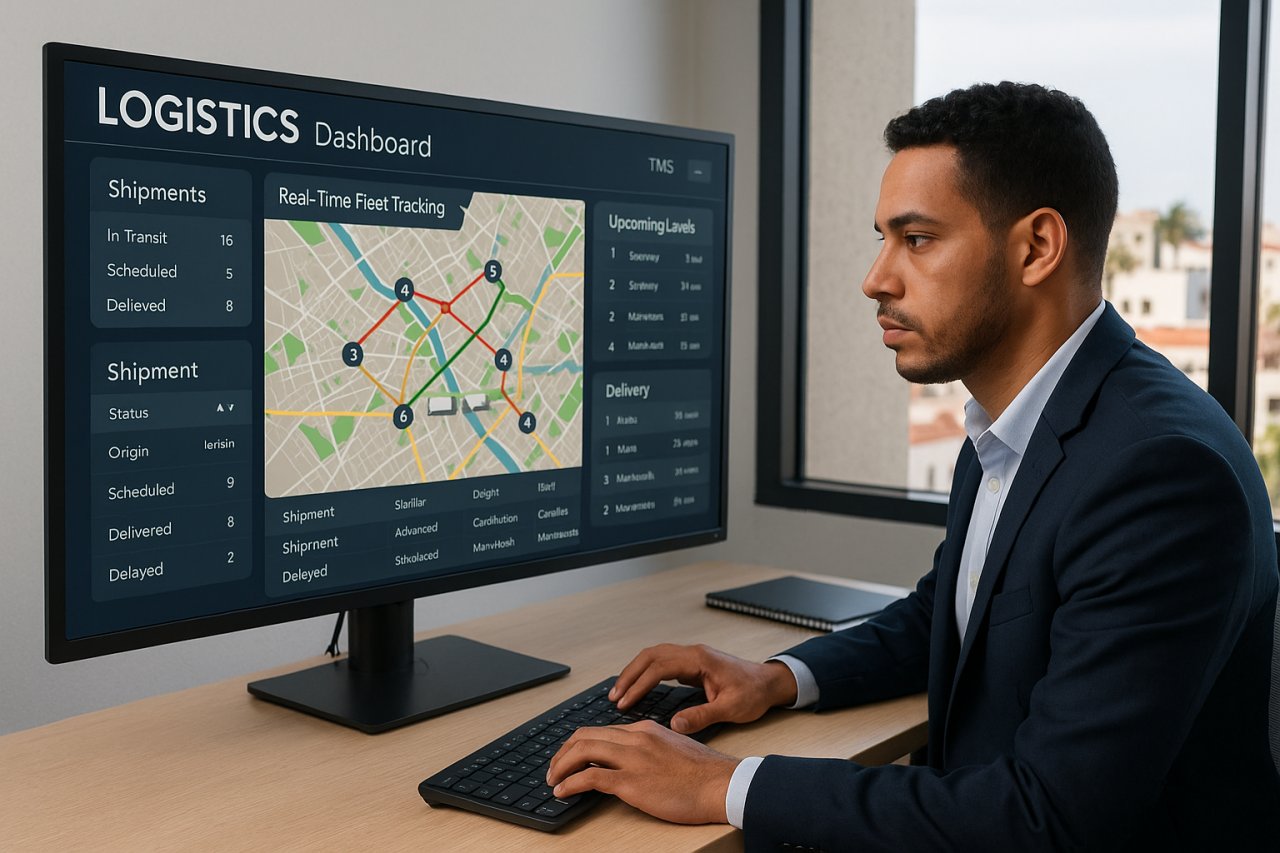
Route optimization goes further: fuel savings between 15 and 25%, delivery capacity increase of 20 to 30% without hiring. Route-optimization tools adopted in Morocco, particularly in port areas like Tanger Med (8.61 million TEU in 2024, +13.4% in one year), allow operators to improve asset utilization and scale their capacity (Mordor Intelligence).
Complete traceability: end of phantom disputes
No proof of delivery? The dispute drags on. With a TMS, each handover generates instant digital proof: photo, electronic signature, GPS timestamp. Disputes drop by 75% (Everest source). You have a complete history for each shipment. Regulatory compliance becomes automatic.
“Everest was very simple to deploy. We immediately gained traceability, and our customers now benefit from real-time tracking to reassure them.”
— Samy Layouni, Minute Pharma
How to choose a TMS adapted to last mile in Morocco
You manage 8 couriers today. In two years, you’re targeting 80 ship-from-store locations. Your TMS transport Morocco must support this growth without changing tools midway. Scalability is not an option, it’s the first selection criterion. Software that caps at 50 users or slows down beyond 200 deliveries/day will cost you dearly in future migration.
Scalability and technical architecture: test before committing
A TMS adapted to last mile must handle seasonal peaks without flinching. You double your volumes during Ramadan or Black Friday? The cloud infrastructure must absorb the load. Test actual capacity: ask for client references handling volumes similar to yours, then multiply by three to anticipate your growth. A system that holds at 500 deliveries/day doesn’t guarantee it will hold at 1,500.
Also check multi-entity management. If you manage multiple brands, multiple cities, or multiple fleet types (bike, motorcycle, car), your TMS must segment operations while maintaining a consolidated view. Minute Pharma gained immediate traceability through simple deployment, but the real value lies in the ability to extend this model to other partner pharmacies without reconfiguring everything.
White label: your identity, their technology
Your customers should never see your TMS provider’s name. Tracking, SMS/email notifications, feedback form: everything must carry your colors and logo. A generic tracking interface breaks your branding effort. A personalized interface builds loyalty. Check that the TMS allows customization: dedicated domain (tracking.yourbrand.ma), complete graphic charter, personalized messages based on delivery status. Some tools lock you into a rigid template. Others give you the keys.
API integrations: zero double entry
You sell on Shopify, WooCommerce, or a custom platform? Your TMS must automatically retrieve orders via API. You use an ERP for billing? Export of delivery data must be native. Each manual re-entry costs time and generates errors.
List your current business tools: e-commerce CMS, ERP, billing software, CRM. Ask the TMS provider which connections are available as standard and which require specific development. A well-documented API gives you autonomy. A proprietary integration makes you dependent.
Local support and field training: a non-negotiable criterion
A TMS without field support in Morocco is an operational risk. You need an interface in French and Arabic, responsive support in your time zone, and a team that understands your local constraints: imprecise addresses, urban traffic, regulatory specificities.
Vlove structured its large-scale cyclo-logistics expansion thanks to a partner who supported operational deployment, not just sold a license. Demand initial training for your dispatchers and drivers, then ongoing support. A support ticket handled in 48h isn’t enough when your fleet is stopped.
Transparent pricing model: calculate cost over 24 months
Cost per delivery or fixed subscription? Both models work, provided there are no hidden fees. Beware of complex pricing grids: activation fees, cost per additional user, API surcharge, support billing after three months. Ask for a detailed quote over 12 months, including your projected growth.
A TMS that costs you 2,000 MAD/month for 500 deliveries can explode to 8,000 MAD/month at 2,000 deliveries if pricing isn’t linear. Compare total cost of ownership (TCO) over 24 months, not just entry price. Pricing transparency often reveals provider maturity.
Key Takeaways
- Prioritize a scalable cloud TMS that absorbs your seasonal peaks without slowdown
- Demand a complete white-label experience (tracking, notifications, dedicated domain)
- Verify native API integrations with your current business tools (e-commerce, ERP, CRM)
- Ensure local French/Arabic-speaking support and field training
- Calculate total cost over 24 months including your projected growth
TMS and decarbonized logistics: a concrete competitive advantage
Your bike deliveries reduce CO₂, but you can’t prove it. In Morocco, the transport sector represents 31% of total CO₂ emissions, with 99% dependence on fossil fuels. This figure places decarbonization at the heart of regulatory and commercial issues. A TMS transport Morocco transforms your ecological impact into a measurable commercial argument.
Automatic carbon reporting: from good intentions to quantified proof
Without data, your environmental commitment remains invisible. A TMS automatically calculates CO₂ emissions per route, per customer, per transport mode. You go from “We deliver by bike” to “Our deliveries saved you 847 kg of CO₂ this quarter.” This traceability meets Framework Law 99.12 climate requirements and appeals to CSR-sensitive customers.
A study of 270 Moroccan transport organizations (2019-2023) demonstrated that route optimization via AI algorithms (XGBoost, R² of 0.88) identifies priority emission reduction levers: distance, payload, vehicle type. Integrated into your TMS, this reporting becomes a commercial differentiator versus players who promise without measuring.
Data-driven cyclo-logistics: scaling without losing control
Vlove structured its large-scale cyclo-logistics expansion through a unified platform. The challenge? Optimizing bike/cargo bike routes with specific constraints:
- Limited range of electric bikes
- Pedestrian zones and traffic restrictions
- Strict time windows in city centers
- Reduced load capacity compared to motorized vehicles
- Weather conditions impacting performance
A TMS adapted to last mile calculates multi-criteria routes: minimum distance + emissions + compliance with urban delivery slots. Result: you increase your delivery capacity by 20 to 30% without hiring, while reducing unnecessary kilometers. Each optimized route generates reusable data to refine your next planning. Cyclo-logistics moves from niche activism status to viable and traceable business model.
The commercial argument that changes everything
“Ecological delivery” is no longer enough. Your B2B customers demand proof. A TMS generates personalized carbon reports per recipient: “Your order was delivered by bike, avoiding 2.3 kg of CO₂ compared to a classic diesel delivery.” This transparency strengthens your credibility and justifies a potential green premium.
For omnichannel retailers, this advantage doubles as a premium customer experience: white-label real-time tracking + notification “Your package arrives by cargo bike in 8 minutes” + carbon balance accessible in customer area. You transform each delivery into a measurable activist act, while building loyalty through service quality.
Taking action
A TMS transport Morocco adapted to last mile is no longer a technological luxury, it’s an operational prerequisite. You save two hours per day, reduce customer calls by 40%, and transform your ecological commitment into a quantified commercial argument. The real question is no longer “Should we digitize?” but “Which TMS to choose to scale without friction?”. Prioritize scalability, white label, native APIs, and local support. Everest supports transport and urban logistics players in Morocco with a platform designed for last mile: automated dispatch, real-time tracking, integrated carbon reporting. Test the solution on your first flows, measure gains, then deploy at scale.
FAQ
Is a TMS suitable for small fleets under 10 vehicles?
Yes, provided you choose an adapted pricing model. Cloud TMS with per-delivery pricing allow you to start without heavy investment. You pay what you consume, and you scale at your growth pace.
How long does it take to deploy a TMS in Morocco?
A well-supported deployment takes 2 to 6 weeks: initial configuration, team training, API integration, field testing. Minute Pharma gained immediate traceability from the first deliveries.
Can a TMS manage multiple transport modes (bike, motorcycle, truck)?
Yes, last-mile platforms like Everest segment routes by vehicle type while maintaining a consolidated view. You optimize each mode according to its own constraints (bike range, truck capacity, pedestrian zones).
Is carbon reporting compliant with Moroccan regulations?
TMS calculate emissions according to recognized methodologies (distance × emission factor per transport mode). This traceability meets Framework Law 99.12 requirements and facilitates your CSR declarations.
Can a TMS be integrated with an existing ERP?
Yes, via API. List your current business tools (ERP, e-commerce CMS, CRM) and verify that the TMS offers native connectors or a documented API. Zero double entry, automatic synchronization of orders and delivery proofs.