TMS Transport: Control Your Deliveries and Reduce Costs in 2026
Your transportation costs have increased by 15% per kilometer. Your dispatchers spend two hours a day on Excel. Your customers call ten times a day to find out where their package is. This situation is unsustainable. Carriers who automate their transport operations reduce their costs by 10% and improve their delivery times by 20%. Those who continue to dispatch manually suffer from rising costs without being able to compensate. A transport TMS centralizes your operations, optimizes your routes in real-time, and gives your customers the visibility they expect.
Key Takeaways
- A TMS reduces kilometers traveled by 15% and freight costs by 5 to 15% from deployment
- Automated dispatch frees up 1 to 2 hours per day and eliminates assignment errors
- Real-time traceability decreases customer calls by 40% and disputes by 75%
- SaaS solutions deploy in 6 to 8 weeks versus 12 to 18 months for on-premise
- Automatic carbon reporting transforms your environmental commitment into a measurable commercial argument
What is a transport TMS and why do you need one in 2026?
A TMS centralizes all your transport management on a single interface
A TMS (Transport Management System) is transport management software that centralizes all your logistics operations: route planning, mission dispatch, real-time tracking, and invoicing. You control everything from a single interface. No more juggling between Excel, phone, and emails.
The last mile concentrates approximately 30% of total logistics costs in 2026 (Meilleurescpi.com). Every inefficiency in this final phase translates into a direct additional cost. TMS software allows you to regain control over this major portion of your expenses.
2026: +15% in costs per kilometer, your margins under pressure
Transportation costs have increased by 15% per kilometer in 2026 (Douzepointcinq.com). This increase directly affects urban carriers, couriers, and retailers managing their own fleet. Without a management tool, you suffer this inflation without being able to compensate.
Every kilometer saved becomes a direct competitive advantage. We’ve often seen operators working from urban micro-hubs realize this advantage: being 5 kilometers rather than 30 kilometers from your delivery zones multiplies possible rotations, reduces costs, improves delivery times, and protects against long-distance freight transport price increases.
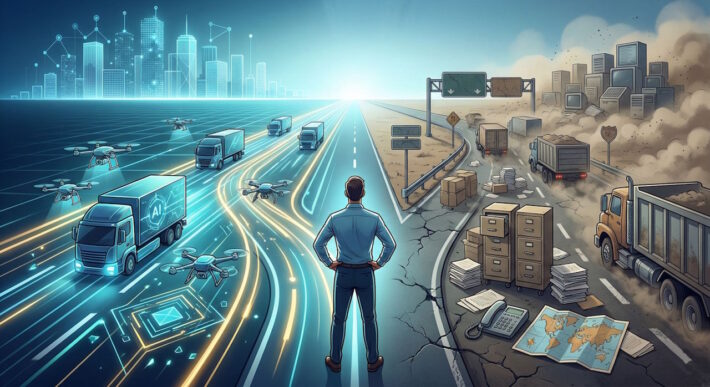
Without TMS: manual dispatch, errors, calling customers
Are you still spending two hours a day dispatching on Excel? Do you receive ten customer calls per day to find out where their package is? This time-consuming process creates no value. Manual dispatch generates assignment errors, non-optimized routes, and a total lack of visibility for your end customers.
Result: your drivers travel more than necessary, your customers are frustrated, and your customer service is saturated. Companies implementing a TMS see a 10% cost reduction and a 20% improvement in delivery times (Gartner study cited by Inbound Logistics).
With a TMS: unified control, automation, real-time traceability
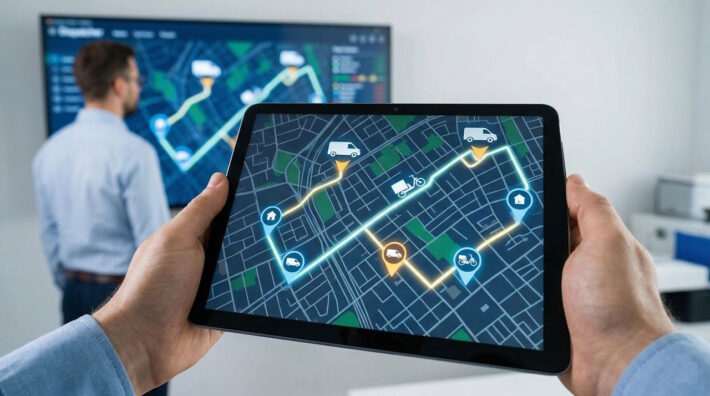
TMS software automates mission assignment based on location, availability, and capacity of your vehicles. Routes are optimized in real-time to account for traffic, delivery time slots, and customer priorities.
Your customers receive a real-time tracking link. They see where their delivery is, receive automatic notifications, and no longer need to call. A transport company reduced its customer service calls by 40% thanks to this automatic traceability.
“Everest was very simple to deploy. We immediately gained traceability, and our customers now benefit from real-time tracking to reassure them!”
Diligo, a cycle-logistics operator, went from 1 to 21 cargo bikes in 2 years with Everest. Their feedback illustrates how an adapted TMS transforms growth capacity without losing operational control.
TMS features that transform your logistics
You manage your routes on Excel. You dispatch manually. You receive 15 calls per day to find out the status of a delivery. This time produces no value. A Transport Management System centralizes these tasks and automates them. The gains are measurable from the first week.
Route optimization: fewer kilometers, more deliveries
A TMS calculates the shortest routes taking into account real-time traffic, delivery windows, and vehicle capacity. Dynamic optimization algorithms recalculate routes in milliseconds as soon as an unforeseen event occurs (closed road, new urgent order).
A last-mile delivery company reduced its kilometers traveled by 15% by switching to Everest (source). For a fleet of 20 vehicles traveling 500 kilometers per day, this represents:
- 50 to 75 kilometers saved daily
- $219,000 to $380,000 saved per year
- Less fuel and vehicle wear
- More possible routes without new investments
Fewer kilometers means less fuel, less wear, more possible routes. You gain efficiency without investing in new vehicles.
Automated dispatch: assigning the right mission to the right courier
Manual dispatch takes time and generates errors. A TMS automatically assigns each mission based on the courier’s location, availability, and vehicle capacity. The management system analyzes in real-time who is closest, who is finishing their route soon, who still has space. Eagles Courses saves 1 to 2 hours per day thanks to this automation.
This freed time allows managing more customers, anticipating activity peaks, or simply breathing. Automated dispatch also reduces empty kilometers: fewer unnecessary returns to the depot, more chained missions.
Unified real-time tracking: complete visibility for you and your customers
Without real-time tracking, your customers call. Your customer service is saturated. A TMS offers complete visibility on each delivery: courier position, estimated arrival time, photographic proof of delivery. Your customers receive automatic notifications. They track their package like on Amazon. A transport company reduced its customer service calls by 40% by deploying Everest. Traceability also reduces disputes by 75% (source).
White-label tracking strengthens your professional image. Your customers only see your logo, not that of an external provider. You control the experience end-to-end.
[placeholder_image]Single interface: centralizing transport orders, loading, invoicing
A TMS groups all your transport operations in a single interface. No more juggling between Excel, phone, emails, and invoicing spreadsheets. You create a transport order, assign a vehicle, track the delivery, and generate the invoice from the same screen. Data flows automatically between modules. No more re-entry. No more oversights.
This centralization also accelerates the integration of new employees. The tool is intuitive. Transport processes are standardized. You scale without administrative complexity.
ERP/WMS integration: automatic synchronization with your supply chain
A TMS doesn’t work in a silo. It connects to your other tools: ERP (commercial management), WMS (warehouse management), e-commerce platform. Transport orders are created automatically as soon as an order is validated. Inventory updates in real-time. Invoicing triggers upon delivery. This synchronization eliminates information breaks. You manage your logistics end-to-end, without manual re-entry.
The global TMS market is expected to reach $68.36 billion by 2033, with annual growth of 17.8%. This dynamic reflects operational urgency: carriers who automate gain efficiency. Others suffer from rising costs.
Shipper TMS vs Carrier TMS: which one for your business?
You’re looking for transport software, but you’re hesitating between a solution for shippers or for carriers. This distinction is not a marketing detail. It determines your ability to effectively manage your transport operations.
Shipper TMS: for retailers and e-merchants managing their own fleet
A shipper TMS is designed for companies that ship goods from their own points of sale. Retailers with ship-from-store, e-merchants delivering from their stores, manufacturers managing their own fleet: you need to manage your shipments, not manage multiple clients.
Typical use case: you own 8 stores in the Paris region. Each store must ship e-commerce orders within a 10-kilometer radius. A shipper TMS centralizes these operations. You plan routes from a single interface. You offer white-label tracking to your end customers. You measure the performance of each point of sale.
The main challenge: maintaining your brand image all the way to delivery. Your customers should never know that an external provider manages delivery. The tracking displays your logo, your colors, your messages. White-labeling becomes your competitive advantage against industry giants.
Carrier TMS: for logistics providers and urban couriers
A carrier TMS responds to an opposite logic. You are a logistics provider, urban courier, cycle-logistics operator. You manage multiple clients simultaneously. You must optimize your multi-client routes, assign missions to your couriers, automatically invoice each client according to different rates.
The global TMS market is expected to grow from $15.24 billion in 2025 to $41.08 billion by 2031. This growth is driven by automation and real-time visibility, reflecting the growing demand for consolidation in fragmented logistics operations.
A recent case illustrates this point well. Arrive Logistics developed a TMS platform with web portals for shippers and carriers that solves the “app fatigue” problem: carriers no longer download dozens of different applications. They access data from multiple brokers from a unified interface. This model reduces operational complexity and improves efficiency.
Everest: a white-label logistics platform that covers both needs
Do you manage your own delivery fleet AND work for external clients? You don’t have to choose between two software solutions. Everest centralizes these two logics in a single platform.
For carriers: multi-client management, automated freight brokerage, differentiated invoicing per client, mobile driver interface.
For retailers: dispatch from multiple points of sale, white-label tracking, unified delivery management, reporting per store.
The real question isn’t “Shipper or carrier TMS?”. It’s: “Do I need a platform that adapts to my current business model AND my growth ambitions?”
How a TMS reduces your costs and improves service quality
You optimize your routes manually. You spend an hour every morning dispatching. Your customers call to find out where their package is. This time creates no value. A TMS transforms these three problems into measurable gains from the first weeks. Here’s how.
Fewer kilometers traveled, more margins preserved
Route optimization reduces distance traveled by 15% on average. A last-mile delivery company saw this decrease from the first month with Everest. Every kilometer saved directly reduces your fuel consumption. In 2026, with costs per kilometer up 15%, this reduction becomes an immediate competitive advantage.
New TMS users reduce their annual freight costs by 5% to 15% from initial deployment. This gain comes from three mechanisms: shorter routes, better consolidated loads, and automatic mission assignment based on actual courier location. You no longer guess. You calculate.
Freed time to manage rather than dispatch
Eagles Courses saves 1 to 2 hours per day since using Everest’s automated dispatch. This time isn’t lost in phone coordination or Excel adjustments. It’s reinvested in business development and service improvement.
Automated dispatch assigns missions based on availability, vehicle capacity, and real-time location. Your teams no longer juggle multiple tools. They manage from a single interface. This centralization reduces data entry errors and mission oversights.
Fewer disputes, more customer trust
Real-time traceability reduces disputes by 75%. When a customer disputes a delivery time, you have time-stamped proof. When a package is reported as not received, you know exactly where it is. This visibility protects your margin and reputation.
A transport company decreased its customer service calls by 40% thanks to real-time tracking. Customers no longer call to ask “where is my order?”. They check white-label tracking. Your customer service focuses on real emergencies, not information requests.
White-label tracking that strengthens your image
Without real-time tracking, your customers call. With white-label tracking, they check. This difference transforms the delivery experience. The customer receives automatic notifications: order taken over, courier on the way, delivery completed. Your brand remains visible from start to finish.
Diligo went from 1 to 21 cargo bikes in 2 years thanks to this traceability. This unified management allows scaling without losing control.
These gains aren’t reserved for large groups. Even with 8 couriers or 5 stores, a TMS makes a difference.
Integrating a TMS into your management system: best practices
You’ve decided to deploy a TMS. First question: how long will it take? In 2026, cloud solutions allow deployment in 6 to 8 weeks, versus 12 to 18 months for on-premise architectures from a few years ago. This scale change transforms the risk equation: you no longer immobilize your teams for months, you test quickly and adjust.
Favor SaaS to avoid infrastructure costs
A TMS SaaS eliminates heavy investments in servers and maintenance. You pay a monthly subscription, benefit from continuous updates, and scale according to your activity.
Cloud solutions reduce transport costs by 15 to 25% through:
- Demand pooling
- Automatic carrier selection via real-time auctions
- Resource elasticity during seasonal peaks
- No initial infrastructure investment
For an urban carrier or a retailer managing its own fleet, this flexibility changes everything. You launch a pilot zone, measure gains, gradually expand. No deployment tunnel. No exploded IT budget.
Integration with your existing tools: ERP and WMS
An isolated TMS is useless. It must communicate with your ERP to synchronize transport orders, invoicing, and customer data. It must connect to your WMS to anticipate loading and optimize departures. In 2024, Descartes recorded a 22% increase in professional integration services, particularly to connect TMS, WMS, carbon calculation, and customs systems. This demand reveals a key point: technical integration isn’t a detail, it’s a performance lever.
At Everest, logistics APIs allow you to connect the TMS to your systems in a few days. You centralize flows, eliminate manual re-entries, gain reliability.
Train your teams for successful deployment
A high-performing TMS remains useless if your dispatchers don’t know how to use it and your drivers don’t understand the mobile app. Training must be short, practical, field-oriented. Favor intuitive interfaces that don’t require a 50-page manual. Test in real conditions with a small team before generalizing.
Diligo, a cycle-logistics carrier, deployed Everest in a few days: “Everest was very simple to deploy. We immediately gained traceability, and our customers now benefit from real-time tracking to reassure them!” This testimony summarizes the essential: a good TMS deploys quickly and generates visible gains from the first weeks.
Progressive deployment: start small, measure, expand
Don’t deploy your TMS across your entire fleet overnight. Start with a geographic area or product line. Measure kilometers saved, time gained, reduction in customer calls. This data allows you to convince your teams and justify expansion. A progressive deployment reduces risks, facilitates adoption, and allows you to adjust parameters before scaling.
In 2026, a well-integrated TMS becomes the nervous system of your logistics. It manages your routes, synchronizes your transport orders, and gives you the visibility needed to anticipate problems before they impact your customers.
TMS and decarbonized logistics: how to manage your environmental impact?
Your bike deliveries reduce CO₂, but you can’t prove it. Your customers ask for a carbon footprint. You respond with estimates. That’s no longer enough. From 2025, nearly 11,700 European companies must report their Scope 3 emissions, including transport. Moving from approximation to granular reporting becomes a regulatory obligation. A TMS transforms this constraint into a commercial advantage.
From saved kilometers to reduced carbon footprint
The last mile concentrates 30% of total logistics costs and 25% of urban CO₂ emissions. Optimizing routes reduces kilometers traveled, therefore fuel consumption, therefore carbon footprint. A last-mile delivery company reduced its kilometers by 15% thanks to Everest route optimization. This gain translates directly into measurable emission reduction, route by route.
| Transport mode | CO₂ emissions per shipment | Variance vs average |
|---|---|---|
| Optimized rail | 0.8 kg | -62% |
| Cycle-logistics | 0.1 kg | -95% |
| Industry average | 2.1 kg | Reference |
| Express air freight | 8.7 kg | +314% |
A TMS automatically calculates emissions by transport mode. This granularity reveals where to act to truly decarbonize, not to display a flattering average.
Automatic carbon reporting: a concrete commercial argument
You manage a cargo bike fleet. You deliver via cycle-logistics. You reduce environmental impact. Except your end customers don’t see it. Automatic carbon reporting transforms your ecological commitment into commercial proof. Each delivery displays its carbon footprint. Each customer receives their monthly impact. You go from “we are green” to “here are your 127 kg of CO₂ saved this month”.
Diligo went from 1 to 21 cargo bikes in 2 years with Everest. Real-time traceability reassures customers. Tracking emissions per route values ecological impact. Retailers seek carriers capable of proving their environmental performance. You give them numbers, not promises.
Cycle-logistics and urban infrastructure: managing decarbonization through data
More than 200 cycle-logistics companies operate in France. Urban logistics hotels are multiplying. Micro-hubs reduce distances. But without a TMS, you’re flying blind. You don’t know which route emits the most. You can’t compare two delivery modes. You don’t measure the effect of a new hub.
Everest centralizes delivery data, calculates emissions per route, identifies decarbonization levers. You know that a hub at 5 kilometers reduces your emissions by 40% compared to a 30-kilometer departure. You prove that your cargo bikes emit 95% less CO₂ than a diesel van. You transform decarbonized logistics into a measurable competitive advantage, not marketing discourse.
Take action
A transport TMS doesn’t replace your industry expertise. It multiplies it. You continue to manage your operations, but you do it with real-time data, automatically optimized routes, and traceability that reassures your customers. Carriers who automate reduce their costs by 10 to 15%, free up 1 to 2 hours per day, and decrease their disputes by 75%. Those who stay on Excel suffer from rising costs without being able to compensate.
In 2026, the question is no longer “what is a TMS?”. It’s “how long can I afford not to have one?”. SaaS transport solutions deploy in 6 to 8 weeks. You test on a pilot zone, measure gains, gradually expand. No deployment tunnel. No exploded IT budget.
If you manage a delivery fleet, whether you’re an urban carrier, ship-from-store retailer, or cycle-logistics operator, Everest centralizes your operations, optimizes your routes, and gives your customers the visibility they expect. You manage your logistics from a single interface. You prove your environmental performance. You scale without losing control.
FAQ
What is the difference between a TMS and fleet management software?
Fleet management software focuses on vehicles: maintenance, consumption, geolocation. A TMS manages transport operations: route planning, mission dispatch, delivery tracking, invoicing. Both are complementary, but a Transport Management System covers the entire delivery cycle, not just vehicles.
How long does it take to deploy a TMS?
A SaaS solution like Everest deploys in 6 to 8 weeks. This timeframe includes configuration, integration with your existing tools (ERP, WMS), and training your teams. A progressive deployment allows testing on a pilot zone before extending to your entire fleet.
Is a TMS suitable for small fleets?
Yes. Even with 5 vehicles, a TMS can reduce your kilometers traveled, automate your dispatch, and improve your traceability. Gains are proportional: fewer kilometers, less time spent dispatching, fewer customer calls. SaaS solutions adapt to your size and scale with your growth.
How does a TMS reduce CO₂ emissions?
A TMS optimizes routes to reduce kilometers traveled. Fewer kilometers means less fuel consumed, therefore fewer emissions. The system automatically calculates the carbon footprint of each delivery and generates detailed reports. You move from rough estimates to measurable data, route by route.
Can a TMS integrate with an existing ERP?
Yes. A modern TMS connects to your ERP via API to synchronize transport orders, invoicing, and customer data. This integration eliminates manual re-entries and ensures data consistency between your systems. Everest offers logistics APIs that enable this connection in a few days.