Route Optimization: Reduce Your Transportation Costs by 15 to 25%

Your margins are deteriorating. Fuel is increasing, customers demand more punctuality, and your teams spend two hours every morning organizing routes on Excel. This manual management generates invisible costs that undermine your profitability: superfluous kilometers, assignment errors, cascading delays. Companies that automate their dispatch reduce their transportation costs by 15 to 25% according to McKinsey. This performance is based on algorithms that eliminate the structural inefficiencies of manual planning. Route optimization transforms your operational constraint into a measurable competitive advantage.
Key Takeaways
- Manual route management requires 1h30 per day on administrative tasks without added value
- Algorithmic optimization eliminates 10 to 15% of kilometers traveled and reduces costs by 15 to 25%
- Real-time tracking reduces customer service calls by 60% and increases punctuality from 70% to 95%
- An all-in-one platform avoids the hidden costs of integrations between fragmented tools
- Operational deployment is completed in one week with positive ROI from the 6th month
Why your manual routes cost more than you think
Your dispatcher spends two hours every morning organizing routes on Excel. They juggle driver constraints, customer time slots, vehicle capacities. This administrative time seems normal to you. It is not.
The lost time is not visible on your invoices
Every day, your teams spend an average of 1h30 on tasks without added value: manual data entry, consolidation of route sheets, verification of driver information. Over a month, this represents a week and a half of purely administrative work. This time could be used to negotiate better contracts, optimize your fleet or develop new customers.
Digitalization allows you to recover up to 1h30 per day per operator, according to 2026 data from Dashdoc. Administrative controls are divided by three. Invoicing, which previously monopolized several days, is now processed in a few hours.
Assignment errors generate cascading costs
- A driver poorly assigned to a route too long for their day
- An overloaded vehicle requiring a second trip
- A forgotten delivery that triggers a customer call, then an emergency reassignment
- Delays that propagate throughout the day
- Growing customer dissatisfaction that erodes your reputation
Your customers suffer the consequences: delivery delays, customer service calls, growing dissatisfaction. Your team spends its time putting out fires rather than strategically managing operations.
Lack of visibility costs you in responsiveness
Without real-time tracking, you discover problems too late. A driver stuck in traffic? You find out when the customer complains. A broken-down vehicle? Impossible to quickly reassign remaining deliveries. This opacity prevents you from anticipating and correcting during the day.
Superfluous kilometers accumulate: non-optimized routes, empty returns, avoidable detours. These 10 to 15% extra kilometers represent several thousand euros per month in fuel and vehicle wear. Without a measurement tool, these costs remain invisible in your operating accounts.
How TMS software reduces your transportation costs by 15 to 25%
Your transportation costs eat into your margins. Fuel, driver time, vehicle wear: every superfluous kilometer directly weighs on your profitability. A TMS software (Transport Management System) transforms this equation by eliminating the structural inefficiencies of manual management. Logistics optimization solutions allow you to reduce transportation costs by 15 to 25%, according to a McKinsey study from 2024. This reduction is based on concrete algorithmic mechanisms that eliminate unnecessary kilometers, automate decisions and maximize your vehicle fill rate.
Route optimization eliminates 10 to 15% of your kilometers
Your dispatcher plans routes by instinct. They know the terrain, but they cannot calculate in real time the 10,000 possible combinations for 30 deliveries. A TMS does it in a few seconds. The algorithmic calculation integrates distances, time slots, vehicle capacities and regulatory constraints to produce the optimal route.
Result: you eliminate 10 to 15% of kilometers traveled. On a fleet that drives 100,000 km per year, this represents 15,000 km saved, or approximately 1,500 liters of fuel and several thousand euros in avoided costs. Mechanical wear decreases proportionally, which extends the lifespan of your vehicles.
Dispatch automation frees up 2 hours per day and reduces errors
Manually dispatching on Excel requires at least 2 hours every morning. This time creates no value: it serves to correct assignment errors, manage unforeseen events and juggle between driver calls. An automated dispatch processes these tasks in a few minutes. You assign deliveries according to driver location, their availability and customer priorities.
Assignment errors disappear: no more packages sent to the wrong driver, no more oversized routes that generate unplanned overtime. Your teams focus on strategic decisions and customer relations, not on basic logistics.
Load consolidation maximizes your fill rate
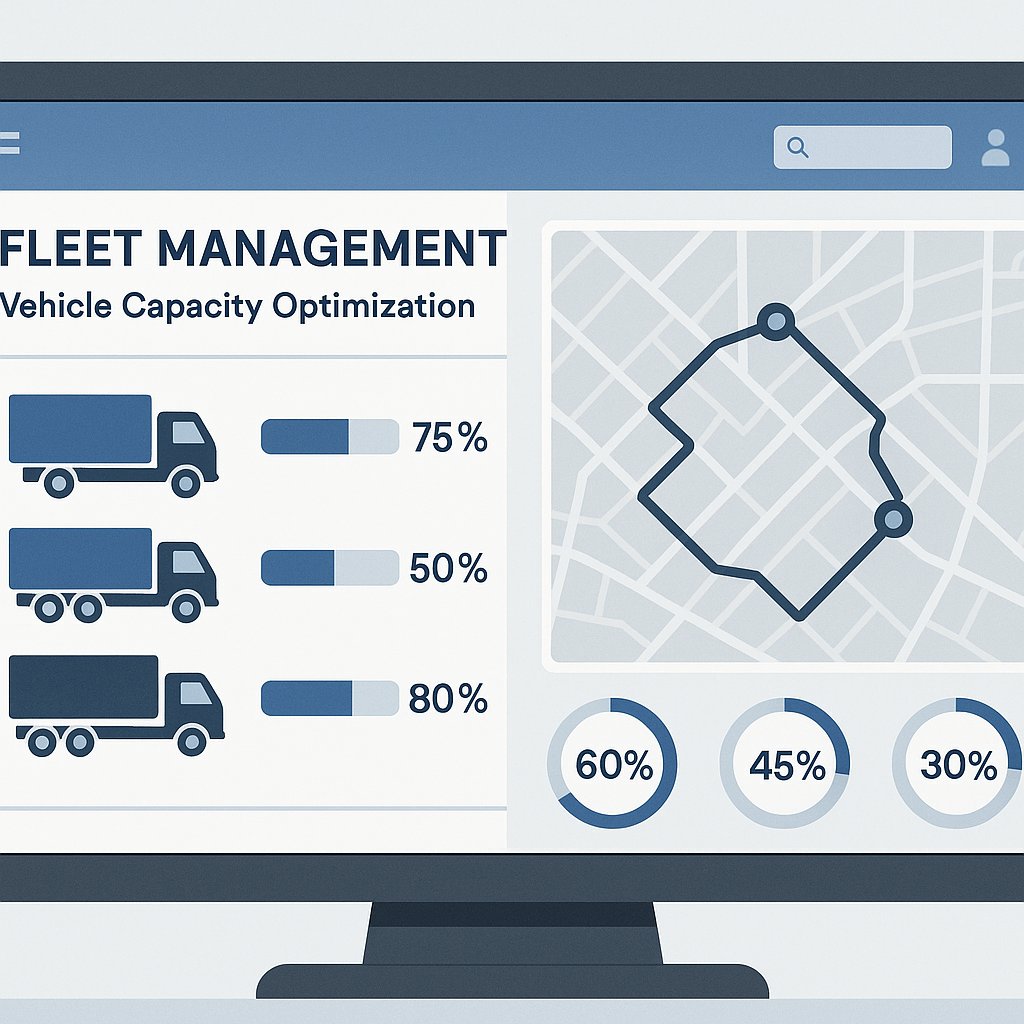
Your vehicles run half empty. You know it, but you don’t have time to optimize each load manually. A TMS software automatically calculates the best fill rate by consolidating compatible deliveries. You reduce the number of empty routes and increase the volume transported per vehicle.
This consolidation directly impacts your costs: fewer routes means less fuel, less driver time and less wear. On a fleet of 10 vehicles, this can represent the elimination of one to two daily routes, or several tens of thousands of euros saved each year.
All-in-one platform vs generic TMS: integration makes the difference
A generic TMS optimizes your routes, but it does not manage customer tracking, invoicing, or reporting. You must integrate three or four additional tools, pay separate licenses and maintain data flows between systems. An all-in-one logistics platform centralizes dispatch, optimization, real-time tracking and invoicing in a single interface.
| Criterion | Generic TMS | All-in-one platform |
|---|---|---|
| Number of tools | 3-4 separate software | 1 single interface |
| Monthly cost | €330-480 (multiple licenses) | €150-300 |
| Integration time | Several weeks | 1 week |
| Risk of data entry error | High (multiple re-entries) | Minimal (automated flow) |
| Team training | Multiple (one tool = one training) | Single |
You eliminate the hidden costs of integration and accelerate your operations. Your drivers use a single mobile application. Your customers receive white-label tracking. Your team manages everything from a unified dashboard. This integration transforms cost reduction into a sustainable competitive advantage.
95% punctuality: how optimization transforms your customer service
Your customers no longer call to find out where their package is. They check the tracking. Your customer service teams no longer spend their day reassuring or apologizing. Route optimization radically changes this reality: compliance with delivery time slots goes from 70% to over 95% with adapted TMS software (source: Droitaufut.com). This measurable reliability transforms your customer relationship and brand image.
Real-time tracking reduces customer service calls by 60%
Without visibility, your customers call. Your switchboard is saturated. A unified real-time tracking reverses this dynamic: recipients receive automatic notifications at each stage (package being prepared, out for delivery, imminent arrival). Direct result: 60% reduction in incoming calls to customer service. Your teams focus on solving real problems, not just providing information.
“The difference between basic tracking and a white-label experience is massive. Your customers stay in your universe: no third-party logo, notifications personalized to your brand, direct link to your customer service if needed.”
The difference between basic tracking (generic tracking number) and a white-label experience is massive. With a white-label logistics platform, your customers stay in your universe: no third-party logo, notifications personalized to your brand, direct link to your customer service if needed. You control the end-to-end experience.
Dynamic reassignment preserves punctuality despite unforeseen events
A driver stuck in traffic. A broken-down vehicle. An unplanned absence. These situations happen every week. Without a tool, you lose half a day manually reorganizing everything. A TMS with real-time optimization automatically reassigns remaining deliveries to the nearest courier, recalculates routes, and notifies affected customers. Overall punctuality is preserved.
This ability to anticipate and react transforms your perceived reliability. Your customers know that even in case of unforeseen events, they receive clear information and a new realistic time slot. This transparency builds trust much more than an unfulfilled promise.
Cycle logistics and urban couriers: what specificities for optimization
Your cargo bikes face constraints that classic algorithms ignore
You deliver by cargo bike in Paris? Your operational reality has nothing to do with that of a road carrier. Low emission zones (LEZ), restricted time slots, pedestrian streets, loading capacities limited to 117 kg on average: so many parameters that generalist optimization software does not take into account. Result: routes theoretically optimal on paper, but inapplicable in the field.
France now has 3,400 cargo bikes in operation, of which 84% are dedicated to cycle logistics (Observatory of professional cycle mobility, December 2024). These fleets travel an average of 24 km per day, with a massive concentration in Île-de-France: 1,450 units, of which 76% in Paris. This urban density requires multi-criteria optimization that simultaneously integrates distance, travel time, local regulations and bike capacity.
Carbon reporting transforms your ecological impact into a commercial argument
Cycle logistics emits 6 times less CO₂ than conventional urban logistics. But without quantified data, this advantage remains invisible to your customers. An adapted management system automatically calculates emissions avoided compared to a light vehicle scenario, and generates detailed reports that can be used commercially.
- Automatic calculation of avoided CO₂ emissions
- Comparison with an equivalent light vehicle scenario
- Generation of customizable CSR reports
- Commercial valorization with shippers sensitive to environmental issues
- Tracking of ecological impact over several months
In Bordeaux, the ColisActiv’ program went from 380,000 packages delivered by cargo bike in 2022 to 720,000 in 2024. Measurable impact: 2,400,000 kilometers of light commercial vehicle avoided, with an average premium of €0.27 per package representing 7.2% of turnover (LUD Report, Ministry of Ecological Transition). These figures become negotiation tools with shippers sensitive to CSR issues.
On-demand dispatch: managing the unpredictability of the courier model
Your activity is divided between two distinct economic models: 55% in planned routes, 45% in on-demand delivery. This duality complicates optimization. Routes require advance planning with geographical grouping of deliveries. On-demand deliveries require real-time dispatch based on the availability and instant location of your couriers.
A software designed for cycle logistics automatically assigns each new delivery to the nearest, available courier who meets capacity constraints. It continuously recalculates routes to integrate new requests without degrading the performance of ongoing routes. This responsiveness reduces customer waiting times and maximizes your fleet’s occupancy rate.
Fragmented TMS vs all-in-one platform: what impact on your efficiency
You manage your routes on optimization software, your invoicing on another tool, and your customer tracking via a third interface? Every morning, your teams juggle between several screens to dispatch a single route. This compartmentalization slows down your operations and generates invisible costs that undermine your profitability.
The hidden costs of a fragmented software stack
A specialized TMS costs between €150 and €300 per month. Add a tracking tool at €100, an invoicing software at €80, and licenses accumulate. But the real cost is hidden elsewhere: in API (Application Programming Interface) integrations to maintain, trainings to multiply for each tool, and hours lost reconciling data between systems.
Your dispatcher exports optimized routes to Excel, then reimports them into the tracking tool. In between, a poorly copied address, a forgotten time slot. These micro synchronization errors cause cascading delays and saturate your customer service. Parnass Transport chose a different approach: develop a custom TMS directly integrating the PTV Logistics route calculation API. Result: total control of the tool and operational performance without multiplying interfaces.
Unified platform: one tool, zero flow disruption
An all-in-one platform centralizes dispatch, optimization, real-time tracking, invoicing and reporting in a single interface. Your dispatcher assigns a route: the driver receives it instantly on their mobile, the customer accesses real-time tracking, and the invoice is automatically generated upon delivery. No re-entry. No risk of duplication or information loss.
Open architecture remains decisive: a unified platform with open APIs allows you to integrate your existing other tools (ERP, e-commerce site, CRM) without rebuilding everything. You avoid the rigidity of monolithic solutions while benefiting from the fluidity of an integrated management system.
White label and scalability: control your growth
With a white-label platform, your customers only see your identity. No third-party logo on the tracking page, no confusion about the sender of notifications. You control the premium delivery experience from end to end and strengthen your professional image.
Scalability becomes transparent: whether you manage 8 couriers or 80 stores, you use the same interface, the same processes, the same training. Your growth does not trigger a tool change or a redesign of your workflows. You double your volume without doubling your operational complexity or structural costs.
How to deploy route optimization without disrupting your operations
You’re still hesitating because you imagine months of migration, disrupted teams and uncertain ROI? This perception slows down 67% of transport SMEs in their digitalization. Except that current optimization platforms are deployed in a few days, not in several months like heavy old-generation TMS.
Operational deployment in one week
Unlike classic IT projects, a modern route optimization software requires no complex infrastructure. You configure your business constraints (delivery zones, vehicle capacities, time slots), you import your customer base, and the system generates its first optimized routes from the next day. An mid-sized company of 85 employees in retail deployed an algorithmic optimization project in 87 days, with positive ROI in 178 days and an annual gain of €145,000.
Integration with your existing tools is done via API: your ERP, your e-commerce site or your CRM continue to function normally. No brutal migration, no double entry, no operational disruption.
Field adoption without resistance
- Intuitive mobile application with delivery order and integrated GPS
- Learning curve reduced to a few minutes
- Essential customer information accessible in one click
- No long training or resistance to change
- Visible gains from the first week of use
Your drivers will not spend hours in training. The mobile application simply displays the delivery order, integrated GPS, and essential customer information. The intuitive interface reduces the learning curve to a few minutes. 34% of SMEs now use AI according to the France Num 2025 barometer, compared to 13% the previous year: this massive adoption proves that tools have considerably simplified.
Automated dispatch immediately frees your teams from manual planning. You measure ROI from the first week: reduction in dispatch time (2h/day recovered), decrease in kilometers traveled (10 to 15%), improvement in punctuality (from 70 to 95%). Each indicator becomes visible in a unified dashboard.
Key Takeaways
- Operational deployment in 1 week without complex infrastructure
- Positive ROI from the 6th month with immediately measurable gains
- Field adoption facilitated by intuitive interfaces
- Continuous support and regular updates included
Continuous support, not a one-time project
You are not alone facing software. SaaS platforms include responsive support, regular updates and progressive skill development. No external consultant billed €1,200 per day, no IT project that drags on. You adjust your parameters as you go, you test new constraints, you refine your business rules.
Route optimization is no longer a luxury reserved for large logistics groups. It is a competitive lever accessible today, which transforms your operational constraints into a measurable competitive advantage.
Summary
The algorithmic optimization of your routes eliminates the structural inefficiencies of manual management: 10 to 15% fewer kilometers, 2 hours of dispatch recovered each day, punctuality that goes from 70% to 95%. These measurable gains translate into a 15 to 25% reduction in your transportation costs. Deployment is completed in one week, with positive ROI from the 6th month. Whether you manage a fleet of urban cargo bikes or regional routes, an all-in-one platform centralizes dispatch, real-time tracking and invoicing in a single interface. You eliminate the hidden costs of multiple integrations and you control your growth without multiplying your operational complexity. Route optimization transforms your logistics constraint into a sustainable competitive advantage.
FAQ
What is the average ROI of route optimization software?
Return on investment becomes positive between 6 and 12 months depending on the size of your fleet. A mid-sized company of 85 employees achieved positive ROI in 178 days with an annual gain of €145,000. Savings come from reducing kilometers (10-15%), dispatch time (2h/day recovered) and reducing customer service calls (60%).
Does TMS work for urban cycle logistics?
Yes, provided it integrates specific constraints: low emission zones, limited loading capacities (117 kg on average), pedestrian streets, restricted time slots. The 3,400 cargo bikes in operation in France require multi-criteria optimization that generalist TMS do not offer. Favor a solution that also calculates carbon reporting to valorize your avoided emissions.
How long does it take to deploy an optimization platform?
A modern SaaS platform is deployed in one week: configuration of business constraints, import of customer base, generation of first optimized routes. Integration with your existing tools (ERP, e-commerce, CRM) is done via API without brutal migration. Your drivers adopt the mobile application in a few minutes thanks to an intuitive interface.
All-in-one platform or specialized TMS: what to choose?
An all-in-one platform centralizes dispatch, optimization, real-time tracking, invoicing and reporting in a single interface. You eliminate the hidden costs of multiple integrations (API maintenance, separate trainings, data reconciliation). A specialized TMS optimizes your routes but requires three or four additional tools to manage customer tracking and invoicing. The choice depends on your need for scalability and control of customer experience.
Does algorithmic optimization replace field expertise?
No, it frees it. Your dispatcher no longer spends 2 hours manually calculating routes: the algorithm processes 10,000 combinations in a few seconds. Your teams focus on strategic decisions, customer relations and managing unforeseen events. Field expertise remains decisive for setting business constraints and adjusting rules as you go.
METADATA:
- Keyword: route optimization
- Brand: Everest
- Target length: 1500 words