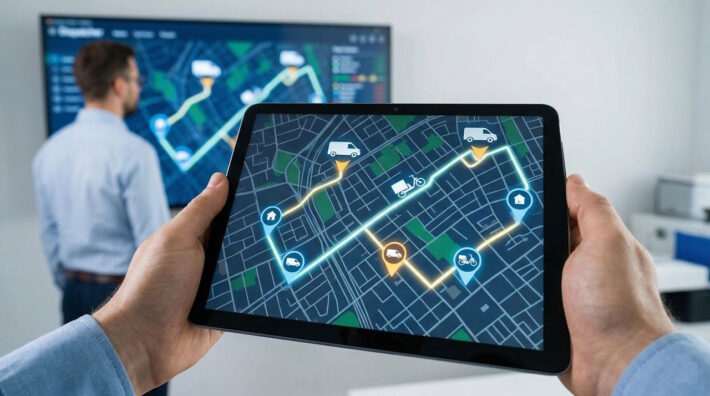
Package Label Printing: How Integrated Delivery Software Eliminates Errors
Your drivers are waiting. Your dispatcher is juggling three screens. A misprinted label blocks the departure for the route. This scenario repeats every morning in transport SMEs that haven’t integrated package label printing delivery software. Result: 1 to 2 hours lost per day on non-value tasks, avoidable addressing errors, and tensions between back office and field. Native integration between your delivery software and your Zebra printers transforms this daily friction into an automated flow: two clicks, zero re-entry, label ready.
Key Takeaways
- Manual export to printing software costs 1 to 2 hours per day and multiplies labeling errors
- TMS-Zebra integration reduces addressing errors by 60 to 80% and accelerates route departure
- DataWedge transforms each scan into timestamped proof of delivery, reducing customer service calls by 60%
- ROI is measurable from the first weeks: hours saved + disputes avoided = investment paid off
Daily operations without integration: why label printing becomes a bottleneck
Double entry that disrupts your dispatch
Your dispatcher opens the TMS. They export the day’s missions to a CSV file. They then open the printing software. They import the file. They verify that the fields match. They launch the print. Between 30 minutes and 2 hours pass each day on this single task alone, depending on the volume of packages processed. Eagles Courses measured this wasted time: 1 to 2 hours per day before switching to integrated printing directly from their TMS.
This time creates no value. Worse: each manual export introduces a risk of format error, truncated address, or unreadable barcode. A mislabeled package means a driver who returns, an unhappy customer, and an avoidable return cost.
Labeling errors that block the route
The label is wrong. The barcode won’t scan. The address is incomplete. These phrases come up several times a week in your exchanges between dispatch and drivers. Each labeling error delays route departure, generates an urgent reprint, and degrades the relationship with the final recipient.
Logistics labeling automation significantly reduces these error rates, as confirmed by Mordor Intelligence’s analysis of the 2025 industrial labels market. Manual processes are the primary source of operational dysfunction in transport SMEs.
Invisible tension between back office and field
Your dispatcher spends time preparing package labels. Your driver waits for printing to finish before leaving. When a label is missing or wrong, it’s the driver who suffers: return to dispatch, reprint, delay on the route. This daily friction wears down teams and slows the entire supply chain.
Diligo eliminated this tension by deploying a TMS with integrated printing: “We immediately gained traceability, and our customers now benefit from real-time tracking to reassure them.” Fluidity between back office and field rests on a single principle: zero re-entry, zero manual export.
Symptoms of a failing labeling process:
- Daily CSV exports to third-party software
- Manual verification of address/package correspondences
- Urgent reprints before route departure
- Frequent calls between dispatch and drivers to correct errors
- Systematic delays on first departures
What Zebra printing integrated with your TMS changes concretely
Two clicks from the mission, zero re-entry
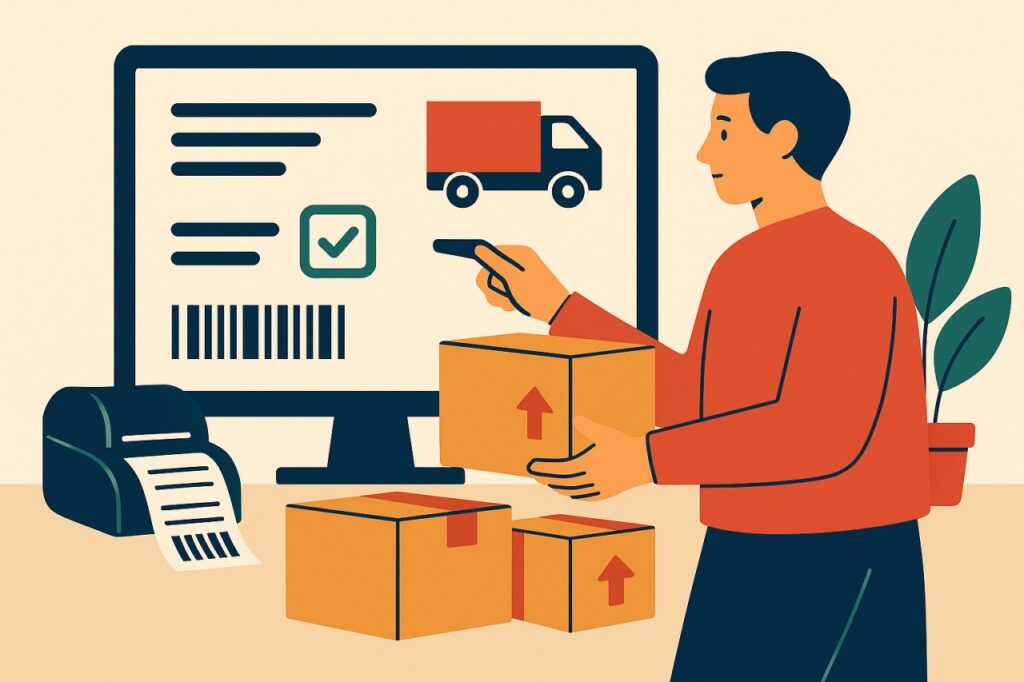
You open the mission in your TMS. You click “Print label”. The Zebra printer outputs the label with the address, barcode, delivery instructions. The package is ready to go.
No CSV export. No copy-paste into third-party software. No manual verification.
The native API between the TMS and printer automatically transmits delivery data in standardized format (GS1, barcode 128, QR code). Eagles Courses measured the gain: 1 to 2 hours per day since they abandoned their manual exports. These hours are reallocated to route optimization and customer relations.
DataWedge: from scan to instant proof of delivery
DataWedge is the Zebra technology that transforms your smartphone or mobile terminal into an industrial scanner. Your driver scans the barcode on the label with the mobile app. The scan instantly uploads to the TMS: time, geolocation, “delivered” status. The proof of delivery is timestamped and archived without manual intervention.
Your customer receives the delivery notification within a minute. Your customer service no longer needs to call the driver to know if the package arrived. Traceability is complete, from label printing to final scan.
Smooth supply chain, from warehouse to route
Integration between delivery software and Zebra printer eliminates flow disruptions. Your dispatcher prepares missions in the morning. They print all labels at once, in route order. Packages are labeled, loaded in the vehicle, ready to go.
No waiting. No last-minute reprint because a label is illegible.
Standardized format (compatible with all logistics scanners) ensures your transport partners, warehouses, and end customers can scan the barcode without error. This fluidity is measurable: your drivers leave on time, your customers are delivered in the announced time slot, your professional reputation strengthens.
Use cases in back office and dispatch
Labeling before departure: 50 packages ready in 5 minutes
Your dispatcher arrives at 7:30 AM. They open the TMS, select the 50 missions for the day, click “Print labels”. Five minutes later, 50 labels come out of the Zebra printer, in the exact route order. Drivers arrive at 8 AM, load the already-labeled packages, and leave without waiting.
Without integration, this same dispatcher would have exported an Excel file, opened separate printing software, manually verified that each address matches the right package, then printed. Average time: 45 minutes. Error risk: high. Drivers wait. The route starts late.
Integrated printing transforms this routine into an automated task. The industrial labels market will reach $33.77 billion by 2026, driven notably by digital printing adoption for mass customization (Mordor Intelligence). This growth reflects a field reality: logistics operators are abandoning manual processes in favor of integrated tools that reduce errors and accelerate dispatch.
Return relabeling: zero re-entry, zero time waste
A package comes back. Recipient absent, incomplete address, or delivery refusal. How many times a week does this scenario repeat for you?
In a classic system, your team must find the address, re-enter it in the printing software, verify the format, then reprint. Average time: 5 to 10 minutes per package. Multiply by 10 returns per day, you lose between 50 minutes and 1h40.
With package label printing delivery software, the dispatcher opens the return mission in the TMS, clicks “Reprint label”. The Zebra printer receives the data automatically: address, barcode, delivery instructions. Two clicks, 30 seconds, done. Zero re-entry. Zero format error.
This fluidity is critical for cargo bike logistics players and urban carriers managing high volumes of returns. Every minute saved at dispatch translates to a driver leaving on time and an optimized route.
Bulk printing for warehouse preparation
You’re preparing a shipment of 80 packages for a retail customer. Your warehouse must label each package with the store address, order number, and a GS1 barcode for tracking. Without integration, your team exports the data, formats it in a spreadsheet, then imports it into printing software. Average time: 1 to 2 hours. Error risk: every copy-paste is a door open to a wrong address.
Integrated printing eliminates these steps. The dispatcher selects the 80 missions in the TMS, clicks “Bulk print”. Labels come out in route order, with the right format, right barcode, right address. The warehouse team sticks labels on packages and loads them in the vehicle. Total time: 15 to 20 minutes.
| Method | Preparation time | Error rate | Traceability |
|---|---|---|---|
| Manual export + third-party software | 1 to 2 hours | 15-20% | Partial |
| TMS-Zebra integrated printing | 15 to 20 minutes | 2-4% | Complete and automatic |
This bulk printing capability becomes a competitive advantage for carriers working with omnichannel retailers. You reduce preparation time, eliminate labeling errors, and guarantee complete traceability from warehouse departure.
Enhanced traceability: each label, a timestamped proof
Each label printed from the TMS contains a unique barcode linked to the mission. Your driver scans this barcode with their mobile app (via DataWedge on Zebra terminals or smartphone camera). The scan automatically feeds real-time tracking: departure time, delivery time, signature or photo proof.
This traceability reduces customer disputes. A recipient claims not to have received their package? You check the mission in the TMS, you see the scan time, photo proof, signature. Case closed in 2 minutes.
Without integration, you must dig through Excel files, cross-reference manual data, and hope the driver noted the time correctly.
The FDA food traceability rule (January 2026) now requires serialized 2D codes to reduce logistics errors and relabeling. This standard, though focused on food, foreshadows a growing requirement for automated traceability across all sectors. Carriers integrating package label printing with their delivery software are getting ahead.
Measurable operational benefits
1 to 2 hours saved per day on dispatch
Eagles Courses abandoned their manual exports and Excel spreadsheets. Result: 1 to 2 hours saved each day on dispatch tasks. That represents 20 to 40 hours per month reallocated to route optimization, customer relations, or managing field contingencies. This gain isn’t anecdotal: it transforms the dispatcher’s role from administrative execution to strategic coordination.
Dashdoc confirms this trend with operators saving up to 1.5 hours per day through TMS digitization including automated printing and integrated billing. Freed time directly translates to additional operational capacity, without hiring.
60 to 80% fewer labeling errors
Labeling errors before departure represent the primary cause of package returns and customer disputes. Wrong address, illegible barcode, format incompatible with the driver’s scanner: these dysfunctions are costly.
TMS-printing integration eliminates manual re-entry and standardizes label format (GS1, barcode 128). Delivery data passes directly from mission to printer, without human intervention.
Result: an estimated 60 to 80% reduction in labeling errors. Drivers leave with the right label, in the right format, from the first pass. Fewer returns, fewer reprints, less tension between dispatch and field.
Enhanced traceability and reduced customer service calls
Each label printed from the TMS is linked to a mission. Barcode scan by the driver feeds real-time tracking. Your customers receive an automatic notification at each step: package picked up, in delivery, delivered. This traceability reduces incoming calls by 60% (Everest data on real-time tracking). Your customer service breathes, your customers are reassured.
Diligo, which deployed Everest on its cargo bike fleet, confirms: “We immediately gained traceability, and our customers now benefit from real-time tracking to reassure them!” The timestamped proof of delivery, automatically generated at scan, closes the file without manual intervention.
Fast ROI: investment paid off in weeks
TMS-printing integration generates ROI in 12 to 24 months via administrative savings (10 to 15 minutes saved per file) and economies on transport disputes (10 to 30% reduction). For transport SMEs, this ROI materializes from the first weeks: hours saved on dispatch and errors avoided quickly offset the cost of license and equipment.
Measurable impact of integrated printing:
- Dispatch time: -60 to 80% (from 1-2h to 15-20 min)
- Labeling errors: -60 to 80%
- Customer service calls: -60%
- Route departures: systematically on time
- ROI: 12 to 24 months (often from first weeks)
How to choose your integrated printing solution
You’ve identified the problem. You’ve measured potential gains. Remains to choose the right solution.
Not all TMS are equal when it comes to package label printing. Some promise integration but deliver a shaky API requiring three months of development. Others support Zebra in theory but crash as soon as you go from 10 to 50 packages per day.
Here are the non-negotiable criteria for evaluating an integrated printing solution for your delivery software.
Hardware compatibility: Zebra is non-negotiable
Your TMS must natively support Zebra printers, particularly ZPL (Zebra Programming Language) and EPL (Eltron Programming Language) languages. Why Zebra? Because it’s the industry standard in logistics. 80% of warehouses and dispatch platforms use Zebra printers for their reliability and printing speed.
Also verify compatibility with other industrial brands (Brother, Datamax, TSC) if you’ve already invested in equipment. A good TMS must adapt to your existing fleet, not the reverse. Digital printing will represent 27.5% of the labels market value by 2029 according to 2025 Forecasts: digital growth in labels. Your solution must follow this evolution without requiring overhaul.
Open API: your TMS must talk to your other tools
Label printing is just one link in your supply chain. Your TMS must be able to connect to your WMS (warehouse management), your ERP (business management), and your billing tools. Without an open API, you remain in a silo. Your data doesn’t flow. You continue to export, reimport, re-enter.
An open API allows you to trigger printing automatically as soon as an order is validated in your ERP, or as soon as a package is scanned in the warehouse. You save even more time. You reduce even more errors. Diligo, grown from 1 to 21 cargo bikes in two years, specifically relied on this interconnection to scale without friction.
Support and training: successful deployment happens in the field
Technical integration isn’t enough. Your dispatcher must understand how to configure label formats. Your drivers must know how to scan barcodes from the mobile app. Your warehouse team must master bulk printing.
Successful deployment requires field support: dispatch training, printer configuration, real-condition testing. Without this, you lose three weeks figuring out why the label prints poorly or why the scan doesn’t upload to the TMS. Favor publishers offering included training and responsive support.
Scalability: your solution must grow with you
You manage 10 packages per day today. You may manage 100 in six months. Your TMS must handle this growth without slowing, without crashing, without requiring migration to another solution. Scalability is measured on three axes: package volume, number of users (dispatchers, drivers, warehouse), and flow complexity (multi-site, multi-carrier, multi-customer).
Test the solution in real conditions. Print 50 labels at once. Verify the API doesn’t saturate. Ask for customer references who scaled with the same tool. Eagles Courses saved 1 to 2 hours per day by abandoning Excel for a unified TMS. This gain remains stable even when volume doubles.
Total cost of ownership: look beyond the TMS license
The price of a TMS license is only part of the equation. Add the cost of Zebra printers (between €300 and €1,500 depending on model), annual maintenance, consumables (labels, ribbons), and training time. Compare this total to the current cost of your wasted hours.
If your dispatcher loses 1.5 hours per day managing printing manually, that represents 30 hours per month, or about €600 in loaded salary. Over a year, €7,200. A Zebra printer and integrated TMS pay for themselves in less than six months. ROI is fast. Gain is measurable. Decision is simple.
Taking action
Package label printing delivery software integrated with your TMS isn’t a technical gadget. It’s an operational lever that eliminates 1 to 2 hours of non-value tasks per day, reduces your labeling errors by 60 to 80%, and smooths coordination between dispatch and field. Carriers who took the step measure ROI from the first weeks: hours saved, disputes avoided, customers reassured.
If you’re still wasting time exporting CSVs, reprinting illegible labels, or managing avoidable returns, Zebra-TMS integration is your next priority project. Everest offers a turnkey solution with native printing, mobile scan via DataWedge, and real-time traceability. Test it in real conditions: your dispatchers and drivers won’t go back.
FAQ
Which Zebra printer to choose to start?
For a volume of 10 to 100 labels per day, a Zebra ZD420 (€300-500) is sufficient. Beyond 100 daily labels, favor a ZD620 or ZT410 for their speed and robustness. Verify ZPL compatibility with your TMS before purchase.
Does integration work with other printer brands?
Yes, provided your TMS supports standard protocols (ZPL, EPL, ESC/P). Brother, Datamax, and TSC are generally compatible. Ask for a compatibility list from your TMS publisher before investing.
How long does deployment take?
Plan 1 to 2 days for technical configuration (printer connection, label formats) and 1 day of dispatch/driver training. A well-supported deployment becomes operational in less than a week.
Can we print custom labels (logo, special mentions)?
Yes. Modern TMS allow creating label templates with your logo, legal mentions, or specific delivery instructions. ZPL format allows total customization.
What happens if the printer breaks down?
A good TMS offers backup printing (PDF exportable to a standard printer). Plan a backup Zebra printer for critical environments. Preventive maintenance (head cleaning, ribbon changes) drastically reduces breakdowns.