No-code, low-code, vibe coding: which approach to digitalize a transport company in 2025?

Building a custom order form, a tracking dashboard, a loading dock interface… These needs are concrete, urgent — and often stuck in an endless IT backlog. In 2025, three approaches are competing for the spotlight: no-code, low-code, and vibe coding. Which one is right for you?
What transport teams actually need
Before talking tools, let’s talk about the real problem.
Operational teams — dispatchers, logistics managers, fleet supervisors — have very specific needs: a tracking portal for a particular client, a form tailored to a specific workflow, a dashboard that doesn’t look like everyone else’s. Custom-built tools, in short.
Except that custom development is slow. Expensive. And often out of reach for a small or mid-sized transport company.
The result: teams cobble things together in Excel, send status updates by SMS, and waste hours on tasks that could be automated. Digitalization stays a promise rather than a reality.
These three families of approaches were born precisely to bridge that gap. Here’s the breakdown.
No-code: digitalization with no technical barrier
What it is
No-code is the promise of building digital tools without writing a single line of code. Through visual interfaces — drag-and-drop, configuration forms, ready-made building blocks — anyone can create an application, a workflow, or a database.
Tools like Airtable, Notion, Bubble, and Zapier popularized this paradigm from the mid-2010s onward.
The advantages for transport
- Fast deployment: a basic dashboard can be up and running in a few hours
- Accessible: no technical skills required
- Low cost: no developer needed
- Perfect for small operations that need to digitalize quickly with limited resources
The limits to know
No-code hits a wall as soon as needs become slightly specific. Connecting your tool to your TMS, managing granular permissions per client, creating an interface truly branded to your colors… generic no-code platforms quickly show their constraints.
In other words: no-code gives you access to what the tool anticipated. Not necessarily what you actually need.
Low-code: more power, still some flexibility
What it is
Low-code is the next step up. It keeps a visual interface to speed up development, but allows a technical profile — a junior developer or a “citizen developer” — to inject code where the platform falls short.
Tools like OutSystems, Mendix, and Microsoft Power Apps fall into this category.
Why it appeals to mid-sized companies
Low-code is often aimed at companies that have some internal IT resource (even a part-time one) and more complex needs than no-code can handle.
- Deeper customization than pure no-code
- Technical integrations possible with ERPs, TMS platforms, third-party APIs
- More robust scalability on high transaction volumes
What gets in the way
Low-code remains a technical discipline. And in many transport SMEs, those profiles simply don’t exist — or are already stretched thin. You’re back to the same problem: depending on a scarce resource to build operational tools.
Add to that the often steep licensing costs, with an ROI that’s hard to justify for occasional or one-off needs.

Vibe coding: the approach that’s changing the game in 2025
What it actually is
The term “vibe coding” emerged in the tech community in early 2025, popularized by Andrej Karpathy. The idea is radically different: you describe what you want in plain language, and the AI generates the code for you. In real time. Without any configuration interface.
You don’t drag blocks. You don’t tick checkboxes. You write — or speak — and the application takes shape.
“I want a page where my client enters a parcel reference and instantly sees the delivery status and estimated time.”
That’s it. The AI understands, generates, previews. You refine it with a few more messages.
Why this is a turning point for logistics
Transport is a sector where every client has their own requirements. A retailer wants to see the day’s deliveries filtered by store. A pharmaceutical shipper wants a clean, urgent-delivery interface. A franchise network wants a consolidated multi-site dashboard.
These are legitimate needs. But until now, companies either standardized at the expense of the client — or hired a developer for a project that took three months.
Vibe coding breaks that pattern. It makes custom tool creation accessible to operational teams, in minutes rather than weeks.
What to watch out for
Vibe coding, promising as it is, isn’t without its pitfalls:
- Output quality depends heavily on the AI model used and the context it operates in
- A generic AI will produce apps disconnected from your information systems
- Without guardrails on exposed data, the security risk is real
That’s why the most effective implementations are those where the vibe coding AI is natively connected to your core business tool — with configurable permissions, a controlled API scope, and already-structured data logic.
Quick comparison
| No-code | Low-code | Vibe coding | |
|---|---|---|---|
| Skills required | None | Technical | None |
| Customization | Limited | Medium to high | Very high |
| Speed | Fast | Medium | Very fast |
| TMS integration | Difficult | Possible | Native (if built-in) |
| Cost | Low to medium | Medium to high | Variable |
| Best for | Quick start | Available IT teams | Specific field needs |
What does this look like inside a TMS?
The question is no longer theoretical. It’s playing out right now, inside everyday tools.
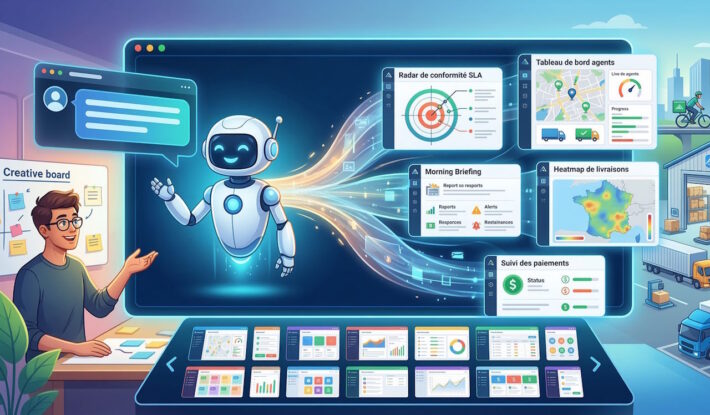
At Everest, we’ve taken this logic to its conclusion with Walter Apps — a vibe coding module built directly into the platform. You describe your need in plain language to Walter, he generates the application, you preview it in real time and refine it by message.
The result: a custom order form, a client tracking interface, a loading dock screen… built in under 15 minutes, without leaving your TMS, without an IT ticket, without a developer.
And because the apps are connected to the Everest API with the scope you define, you stay in full control of what each user can see. No data accidentally exposed. No external workarounds.
That’s what useful vibe coding looks like in transport: not an impressive on-stage demo, but a tool that saves your team time starting tomorrow morning.
Which approach is right for your business?
There’s no universal answer — but here are some useful markers.
You’re starting your digitalization journey and need to structure your processes quickly with limited resources → no-code can be a solid starting point for simple use cases (forms, lightweight automations).
You have an internal IT resource or a technical profile available and need complex integrations with existing systems → low-code offers more robustness and control.
You’re already running a TMS and your field needs are evolving fast — every client has their own requirements, every workflow its own interface → native vibe coding is the most agile and fastest path to value.
The good news: these three approaches aren’t mutually exclusive. Many forward-thinking transport companies combine them — a TMS as the foundation, Zapier or n8n automations for repetitive flows, and vibe coding for bespoke operational interfaces.
The key takeaways
In 2025, digitalizing a transport business is no longer an IT department matter. Operational teams now have the tools to build what they need themselves — as long as they choose the right approach.
No-code to move fast. Low-code to go further with a technical profile. Vibe coding to create truly custom tools, without waiting.
The real question is no longer “do we have the resources to digitalize?” — it’s “which tool lets us move forward today?”