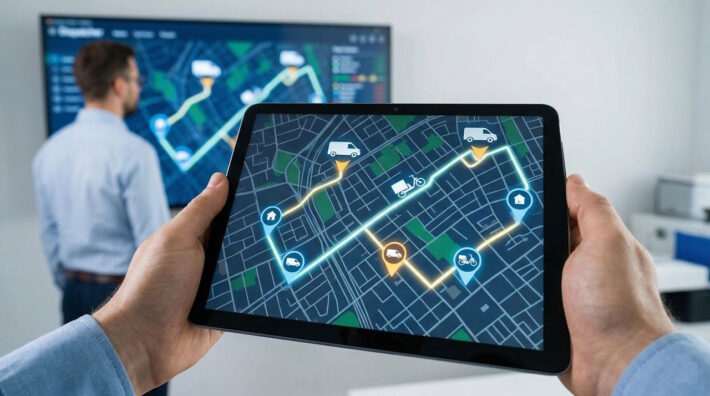
Moving Company Software: How to Save 30% Operational Time

Your teams spend more time coordinating than moving. Your dispatchers juggle between Excel, phone calls, and spreadsheets to organize routes. Meanwhile, your competitors automate, reduce costs, and improve customer experience. This operational inefficiency costs you 30% of your productive time and weakens your competitiveness in a market growing at 5.2% annually. Proper moving company software transforms this loss into measurable advantage: fewer errors, more deliveries, better profitability. Here’s how to choose and deploy the tool that will make the difference.
Key Takeaways
- Manual management absorbs 30% of productive time on avoidable administrative tasks
- A last-mile TMS reduces kilometers traveled by 20 to 30% and disputes by 75%
- Real-time tracking decreases customer calls by 40% and improves NPS
- Quick integration and field support determine actual adoption by your teams
- Automation becomes a survival condition facing rising operational costs
Why moving companies lose 30% of their time on manual management
You still spend two hours per day dispatching your teams on Excel? You juggle between phone, spreadsheets, and driver coordination to organize your routes? This time creates no value. It costs you money and weakens your competitiveness. Moving companies that manually manage their operations lose up to 30% of their productive time on avoidable administrative tasks.
Manual dispatch: a time and error drain
Every morning, your dispatchers reconstruct the route puzzle. They check driver availability, calculate routes, adjust customer schedules. For a fleet of 8 vehicles, this coordination absorbs 10 to 15 hours per week. Hours that generate neither revenue nor customer satisfaction.
Planning errors cost even more:
- A driver sent to the wrong place generates cascading delays
- Unplanned overtime erodes your profitability
- An unhappy customer saturates your customer service
- A dispatch error mobilizes three people to fix it
- Each incident generates an average of 45 minutes of lost time
Absent traceability: when your customers overwhelm your customer service
Without real-time tracking, your customers call. They want to know where their move stands. When the team will arrive. If the truck is on its way. Your customer service spends 40% of its time answering these basic questions. Questions that should never reach you.
This lack of visibility damages your professional image. Your competitors already offer real-time tracking. Your customers compare. They notice you’re still operating the old way. This perception weighs on your recommendation rate and your ability to charge a premium.
Disputes: the hidden cost of manual management
Without digital proof of delivery, disputes multiply. A customer contests the arrival time. Another claims a piece of furniture is missing. You have no objective data to settle it. Your teams spend hours reconstructing the facts. Your billing slows down. Your margins erode.
Companies that have automated their traceability see a 75% reduction in disputes. They invoice 85% faster. They free their teams for value-added tasks. Facing these time and money losses, proper transport TMS becomes a measurable competitive lever.
What is a TMS and why it transforms moving operations
A TMS: the centralized platform that replaces Excel and phone
A TMS (Transport Management System) centralizes planning, optimization, and tracking of your transport operations on a single interface. You manage your routes, drivers, and customers from one screen. No more juggling between Excel, WhatsApp, and phone calls to know where each move stands.
Concretely? The TMS automatically calculates optimal routes, dispatches missions based on actual availability, and updates statuses in real time. Your teams save two hours per day. Your customers receive automatic notifications. Your disputes decrease by 75% (source: Everest).
Generic TMS vs last-mile TMS: a distinction that changes everything
A generic TMS manages long-distance flows between warehouses. A specialized last-mile TMS orchestrates complex deliveries to the end customer: tight time slots, residential addresses, frequent customer interactions. For moving, this distinction determines your ability to keep your promises.
| Criterion | Generic TMS | Last-Mile TMS |
|---|---|---|
| Use case | Long-distance flows between warehouses | Complex deliveries to end customer |
| Dispatch | Manual or semi-automated | Automated by position and load |
| Customer tracking | Limited or absent | Real-time with notifications |
| Digital POD | Basic | Signatures and photos on mobile |
| Optimization | Simple routes | Time slots + residential addresses |
The last-mile TMS integrates three functions absent from generic tools: automated dispatch that assigns each mission to the right driver based on position and load, customer tracking that informs the recipient in real time, and digital POD (Proof of Delivery) that captures signatures and photos on mobile. These functions eliminate repeated customer calls and accelerate billing by 85% (source: Everest).
Measurable benefits from the first weeks
A proper TMS produces immediate and quantifiable gains. Your customer calls drop by 40% thanks to automated tracking (source: Everest). Your dispatchers recover two hours per day, which they reinvest in customer relations or route optimization. Your disputes reduce by 75% because each step of the move is tracked and timestamped.
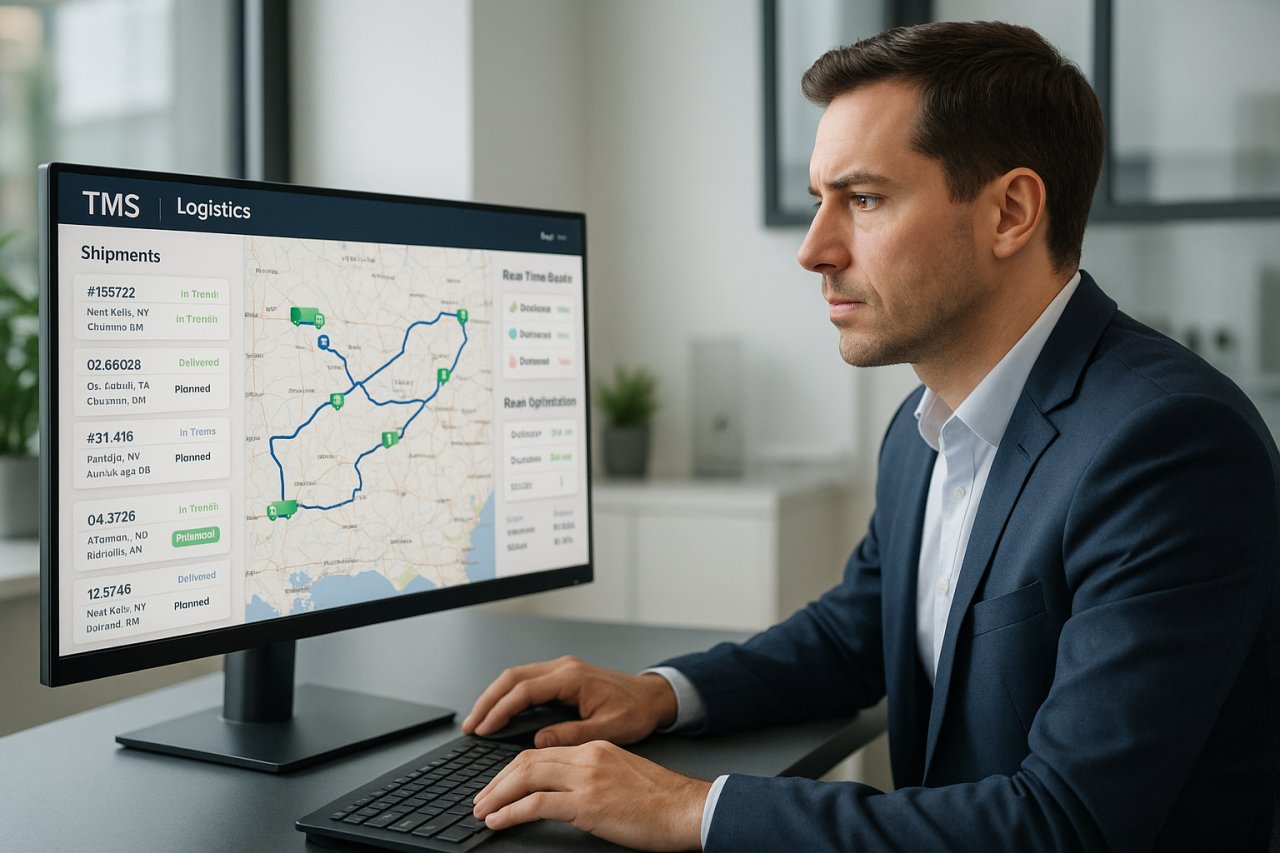
“Consolidated moving requires algorithmic optimization that only a TMS can manage effectively.”
Consolidated moving, which now represents 30.9% of the market and has grown 68% since 2022, perfectly illustrates this need for automation. Pooling several moves on the same route requires algorithmic optimization that only a TMS can manage. You reduce your costs and carbon footprint while maintaining service quality.
Now that you know what a TMS can do, let’s see how it concretely integrates into your daily operations.
The 4 features of moving software that generate immediate ROI
You’ve understood the problem. You know what a TMS is. Let’s talk results. Not in six months. Not after a complex migration. From the first weeks.
Well-designed moving company software rests on four functional pillars that create measurable value immediately. Each addresses an identified time or money loss. Each generates quantifiable gain.
Route optimization: reduce kilometers traveled by 20 to 30%
Your drivers drive too much. Not due to incompetence. Due to lack of tools. Manual dispatch cannot calculate the optimal route between 12 delivery points considering traffic, time slots, and vehicle capacities.
A TMS does it in seconds. Route optimization reduces distances traveled by 20 to 30% according to AntsRoute and Shiptify. Less fuel, less wear, more deliveries per day. Licorne Express saved up to 50% operational time thanks to this single feature.
The calculation is simple: if your teams drive 500 km per day, you eliminate 100 to 150. Every week. Without additional effort.
Automated dispatch: free 2 hours per day and eliminate errors
How much time does your dispatcher spend manually assigning missions? Calling back drivers to confirm? Managing unforeseen events live? Two hours minimum. Often more.
Automated dispatch assigns routes according to configurable business rules: driver skills, vehicle types, geographic zones, emergencies. No more oversights. No more duplicates. No more driver discovering an impossible mission at 8 a.m.
This time saving frees your teams for value-added tasks: customer relations, strategic optimization, business development. You reduce costly errors: delays, disputes, unplanned overtime.
Unified real-time tracking: reduce customer calls by 40%
Without visibility, your customers call. “Where is my mover?” “When is he arriving?” Your customer service is saturated. Your image deteriorates. You waste time reassuring instead of delivering.
Unified real-time tracking gives your customers and teams the same information simultaneously. Vehicle position, estimated arrival time, mission status. Everyone sees the same thing. Calls drop by 40% (Everest data on transport traceability).
Your dispatchers manage without calling. Your customers are informed automatically. You gain professionalism and operational efficiency.
Automatic carbon reporting: transform ecology into commercial argument
You deliver by cargo bike? In electric vehicles? You optimize your routes to reduce CO₂? Perfect. But can you prove it to your customers?
Automatic carbon reporting calculates and documents the ecological impact of each delivery. Avoided kilometers, reduced emissions, comparison with a classic scenario. It’s no longer discourse. It’s quantified proof you can integrate into your commercial proposals.
In 2026, decarbonization is no longer optional. It’s a selection criterion. Your competitors promise. You demonstrate. This advantage translates into conversion rate and customer loyalty.
How white-label tracking builds customer loyalty in moving
Your customers call three times a day to know where their move stands
Moving generates natural anxiety. Your customers have entrusted their most precious belongings to your team. Without visibility, they call. Once in the morning to confirm the time. Once at noon to check progress. Once in the afternoon to anticipate arrival. Your switchboard is saturated. Your teams waste time reassuring instead of delivering.
White-label real-time tracking eliminates 40% of these calls. Your customers receive personalized SMS and email notifications at each step: team departure, arrival in 30 minutes, delivery completed. Under your identity. With your logo. Without them knowing an external platform runs the system.
Tracking transforms anxiety into measurable trust
Live GPS tracking allows your customers to visualize the truck’s position in real time. No more calling to know if the team arrives in 10 minutes or 2 hours. This transparency reduces the mental load of moving and directly improves your NPS.
Real-time tracking SaaS platforms become a differentiation standard in a market growing at +5.2% annually. Your competitors who don’t offer this visibility lose customers to those who do.
White label strengthens your professional image without technical investment
You don’t need to develop your own tracking application. A white-label solution lets you offer a premium experience under your identity, without mobilizing your technical resources. Your customers receive personalized notifications that strengthen your brand image.
Result: immediate reduction in customer service load and improved perception of your professionalism. You spend less time managing customer anxiety and more time optimizing your operations.
Integrating a transport TMS: what you need to know before choosing
Ease of integration: the criterion that determines your production launch
How many weeks have you already lost on an IT project that was supposed to “plug in easily”? Ease of integration determines whether your TMS will be operational in 10 days or 6 months.
Check three elements before choosing:
- Availability of documented APIs to connect your existing tools (ERP, accounting, CRM)
- Existence of native connectors with your partner carriers
- Actual deployment time observed at similar clients
A TMS requiring three months of configuration and two dedicated developers is not suitable for a moving SME. Interconnection with carriers must be native, not custom development billed on a time-and-materials basis.
Scalability: a tool that grows with you, not against you
You manage 8 drivers today. In 18 months, you may have 25. Your moving company software must absorb this growth without technical migration or doubling costs. Scalability means a single interface to manage 8 vehicles or 80, progressive pricing that doesn’t penalize your growth, and architecture that supports adding new branches without complete reconfiguration. Diligo went from 1 to 21 cargo bikes in 2 years with the same platform. No tool change. No operational disruption. Same centralized control. A TMS that forces you to change solutions every three years costs three times more than announced.
Field support: the support that makes the difference between adoption and abandonment
Your teams aren’t IT specialists. A TMS without concrete training and responsive support ends up abandoned in favor of Excel.
Key Points
- On-site training mandatory for dispatchers and drivers
- Documentation accessible in English, not technical jargon
- Responsive support: response in less than 2 hours, not 48 hours
- Change management support included in the contract
Evaluate the quality of change management support: on-site training for dispatchers and drivers, accessible documentation in English, technical support responsiveness in case of field blockage. The 40% reduction in customer calls observed at several Everest clients comes not only from technology, but from actual adoption by teams. Support that responds in 48 hours is useless when your dispatcher is blocked at 7 a.m.
The trap of “all-in-one” solutions that promise everything and deliver little
Beware of platforms announcing they cover accounting, HR, dispatch, billing, and customer relations in one tool. These solutions often require costly custom developments to actually work. You end up with a complex system that does 30% of what you need and requires an external integrator billed at $1000 per day. Favor a specialized last-mile TMS that integrates cleanly with your existing tools via API. You keep your accounting software, you plug in the TMS for dispatch and tracking. Each tool does its job.
2026 projection: automation is no longer a luxury, it’s a survival condition
Energy and logistics costs increase by 30% on average since 2024. Your margins compress. You can no longer absorb these increases without optimizing your operations. Manual dispatch generates 15 to 20% unnecessary kilometers. Approximate planning leads to unbilled overtime. Carbon reporting becomes mandatory for B2B tenders. Automation via proper TMS transforms these constraints into measurable competitive advantages: reduced operational costs, improved profitability per route, commercial differentiation on ecological impact. Movers who automate in 2026 gain market share. Others suffer pricing pressure without action levers.
Taking action
You lose 30% of your productive time on manual coordination. Your competitors automate and gain profitability. Proper moving company software reduces your kilometers by 20 to 30%, your disputes by 75%, and your customer calls by 40%. These gains are measured from the first weeks, not in six months.
Quick integration, scalability, and field support determine your success. Favor a specialized last-mile TMS that integrates with your existing tools rather than a complex system that promises everything. In 2026, automation is no longer a luxury: it’s a survival condition facing rising operational costs.
Everest supports moving companies in their digitalization with a TMS designed for last mile. Real-time tracking, automated dispatch, carbon reporting: features that generate immediate ROI. Discover how Everest transforms your operations.
FAQ
How long does it take to deploy a TMS in a moving company?
A well-designed TMS deploys in 10 to 15 days with team training included. Solutions requiring three months of configuration are not suitable for SMEs. Check actual timelines observed at similar clients before choosing.
Can a TMS really reduce disputes by 75%?
Yes, thanks to digital traceability. Each step of the move is timestamped and geolocated. Proof of delivery (POD) with signature and photos eliminates disputes about schedules or condition of goods. You invoice 85% faster.
Should Excel be abandoned completely?
No, but Excel should serve analysis, not operational management. The TMS handles dispatch and real-time tracking. You export data to Excel for your strategic reporting. Each tool does what it does best.
Does white-label tracking cost more?
No. White label is included in modern TMS. Your customers receive notifications under your identity without technical surcharge. You strengthen your professional image without developing your own application.
How to measure transport TMS ROI?
Three immediate indicators: reduction in kilometers traveled (20-30%), decrease in customer calls (40%), reduction in disputes (75%). Add time freed for your dispatchers (2h/day) and billing acceleration (85% faster). ROI is measured from the first month.