Laboratory Sample Transport: Why a Specialized TMS Becomes Essential
Your biological samples travel under critical conditions. Every degree above 8°C compromises the analysis. Every 30-minute delay can invalidate a diagnosis. Every incident engages your legal liability. Yet, 60% of laboratories still manage these transports on Excel, without real-time visibility, without proof of compliance, without the ability to anticipate. This artisanal management doesn’t scale. It exposes you to costly disputes, irreplaceable sample losses, and a degraded professional image. A specialized TMS transforms this fragility into a measurable competitive advantage.
Key Takeaways
- Biological samples require total traceability (temperature, time, POD) to comply with ADR 6.2 and ISO 15189 standards
- A specialized TMS reduces disputes by 75% and frees up 2 to 4 hours of dispatch per day
- AI route optimization increases fill rate by 20 to 30% and reduces delivery times by 15 to 30%
- Native integration with LIMS and ERP eliminates re-entry and automates billing
- The choice between shipper TMS and carrier TMS depends on your position in the logistics chain
Why laboratory sample transport requires a specialized TMS?
The logistics market for laboratories reaches $5.2 billion USD in 2024 and is expected to grow by 70% by 2033. This explosion reflects a reality: laboratory sample transport is nothing like a standard delivery. Each run engages your legal liability. Each incident can destroy irreplaceable analyses. Each delay compromises a diagnosis.
You transport evidence, not packages
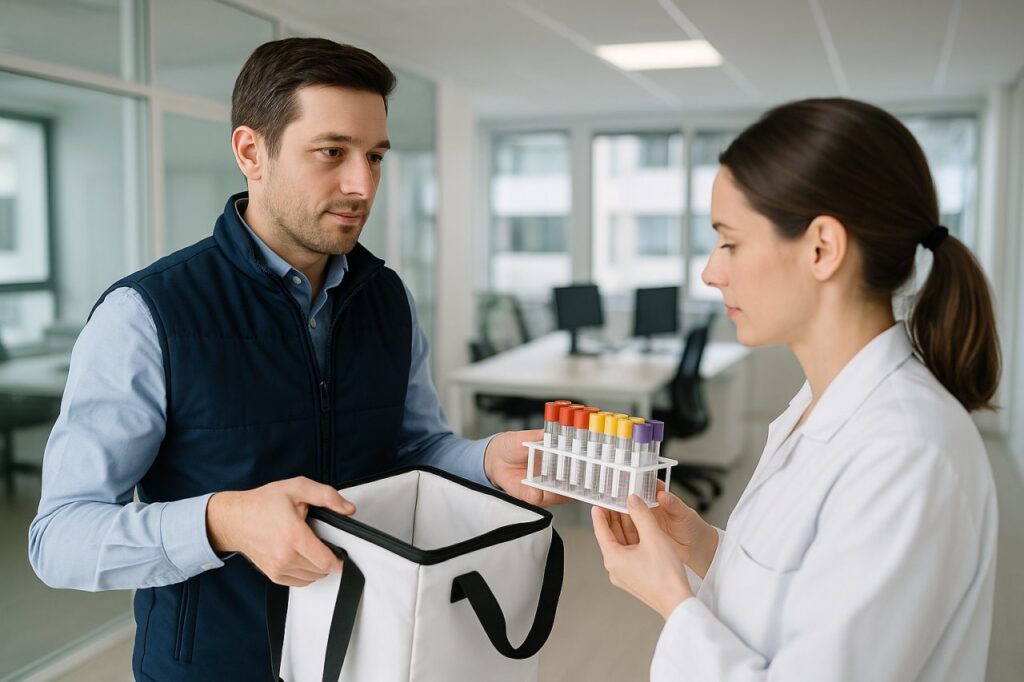
A blood sample loses its validity in a few hours. A specimen for genetic analysis requires a stable temperature between 2°C and 8°C. A break in the cold chain? The sample becomes unusable. The patient must return. The laboratory loses its credibility. You lose the contract.
ADR 6.2 regulations require a specialized carrier for biological materials classified as UN 2814 and 2900. In case of loss or incident, you must immediately alert security services. Without automatic documentation of each step, you’re piloting without a safety net. The Inserm Guide on biological sample transport details these obligations:
- Controlled and documented temperature
- Maximum time respected according to sample type
- Complete traceability of the chain of custody
- Packaging compliant with safety standards
- Specialized driver training
Your Excel won’t prove anything in court
51% of laboratories adopt AI for their diagnostics in 2026. Their analyses gain precision. But their logistics remain archaic. You manage your runs on spreadsheets? You call your drivers to know where they are? You have no time-stamped proof of temperature during transport?
You’re flying blind. No real-time visibility. No ability to anticipate a delay. No exploitable data to optimize your routes. And above all: no proof in case of dispute. A client contests a delay? You only have your word. A sample arrives degraded? Impossible to prove that the temperature break occurred after your delivery.
Complexity grows, your tools stagnate
The hospital segment represents the strongest growth in the biological sample collection kit market: 8.7% CAGR between 2024 and 2032. More volumes. More collection points. More regulatory constraints. Your manual methods don’t scale. Each new run adds stress. Each new client multiplies error risks.
A specialized TMS transforms this complexity into competitive advantage. Automatic traceability. Real-time temperature alerts. AI route optimization. Documented compliance for each delivery. You move from operational survival to strategic management.
Features of a transport TMS adapted to biological samples
You still manage your sample runs on Excel? Each line of your spreadsheet represents a risk: unmonitored temperature, unmet deadline, no proof in case of dispute. A specialized TMS software transforms this artisanal management into industrial control, with total traceability and automatic compliance.
GPS traceability and timestamping: proof at every step
A TMS software automatically records every event in the transport chain: pickup time at the laboratory, passage at the recipient, delivery signature. This GPS traceability coupled with timestamping creates an indisputable chronology. In case of dispute over a degraded sample, you have documented proof: maintained temperature, respected deadline, established responsibility. ParcelValue France, specialist in biological sample transport compliant with ADR and IATA standards, integrates this traceability into its comprehensive logistics solutions to secure the chain of custody end-to-end.
Real-time temperature alerts: anticipate before the break
IoT sensors connected to the TMS continuously monitor temperature. As soon as a drift is detected – for example, a faulty insulated container – the system sends an immediate alert to the dispatcher and driver. You intervene before the sample is lost. This reactivity reduces incidents by 75% compared to manual management where the drift is only discovered upon arrival, too late to act.
“Real-time temperature monitoring transforms reactive management into proactive control. You detect anomalies before they compromise the sample.”
Digital PODs and automated regulatory compliance
Digital Proof of Delivery (POD) replace paper forms: electronic signature, photo of delivered sample, barcode scan. This data automatically feeds your exports for ISO 15189 and GDPR audits. The European SoHO regulation, which simplifies the circulation of human biological samples in preclinical research since 2026, favors this dematerialization. Your TMS generates compliance reports with one click, without manual re-entry. You save 2 to 4 hours per day on transport operations management, time reallocated to optimizing your operations.
Route optimization: gain 15 to 30% on delivery times
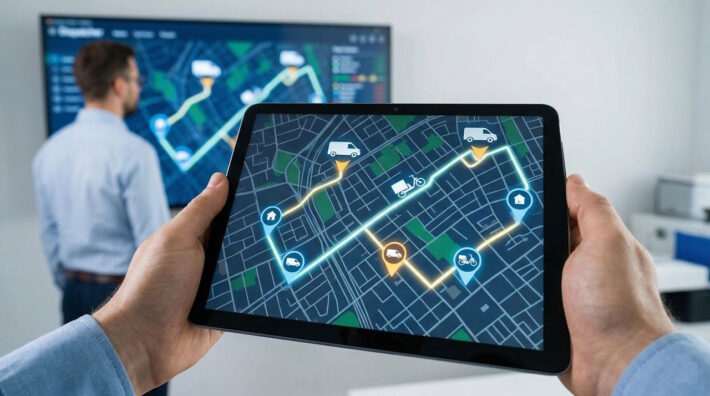
AI integrated into the transport management software calculates the shortest routes taking into account real-time traffic, laboratory time windows, and sample priority. This optimization reduces delivery times by 15 to 30%, a critical factor for short-lived samples like blood specimens or biopsies. You deliver faster, with fewer kilometers traveled, and reduce costs in the process.
How a TMS software reduces costs and operational risks?
You manage 40 runs per day. Three incidents per week. Two hours of manual dispatch each morning. Your team spends as much time managing problems as transporting. This isn’t a resource problem. It’s a tools problem.
Automatic traceability eliminates 75% of disputes
Each undocumented incident becomes a dispute. Each dispute costs between €500 and €3,000 in investigation time, commercial gestures, and customer loss. A transport TMS automatically records each step: pickup time, temperature during transit, electronic signature at delivery. You no longer search for who is responsible. The system documents everything, in real time.
Result: you reduce disputes by four. Remaining incidents are resolved in 10 minutes instead of two days. Your credibility with laboratory clients strengthens. They know you can prove what you claim.
Automated dispatch frees up 2 to 4 hours per day
You open Excel at 7:30 am. You call your couriers one by one. You manually replan when an urgent sample arrives. This time creates no value. A transport management software automatically assigns each run to the best courier according to their position, availability, and temperature constraints. Your teams receive their optimized routes on their mobile. You supervise from a single interface.
This time saving translates directly into operational capacity. You manage transport operations three times more efficiently without recruiting. Your administrative cost per delivery drops by 40%. You reallocate this time to customer relations or business development.
| Indicator | Before TMS | With TMS | Gain |
|---|---|---|---|
| Daily dispatch time | 2-4h | 30 min | -75% |
| Monthly disputes | 12 | 3 | -75% |
| Administrative cost per delivery | 100% | 60% | -40% |
| Daily customer service calls | 25 | 10 | -60% |
AI optimization increases fill rate by 20 to 30%
Every empty kilometer costs. A modern TMS calculates routes taking into account time windows, temperature constraints, and priorities. It groups compatible runs. It anticipates empty returns and proposes repositioning missions.
Result: you transport more samples with the same number of vehicles. Your cost per kilometer decreases. Your profitability increases without increasing your rates. This optimization is measurable from the first week of deployment.
Real-time tracking reduces customer service calls by 60%
Without visibility, your clients call. Your customer service saturates. Your teams spend their day answering “the sample arrives in 20 minutes.” A TMS software automatically sends notifications at each step: pickup confirmed, in transit, delivered. Your clients track their sample in real time, like an Amazon package.
You reduce incoming calls by 60%. Your team focuses on real emergencies. Your professional image strengthens. You offer service quality comparable to major players, with your own means.
Integration with your other tools: ERP, LIMS, laboratory systems
Your TMS should not be another silo
You already manage a LIMS for your samples, an ERP for your billing, perhaps a CRM for your clients. Adding a TMS that doesn’t communicate with anything amounts to creating a new friction point. Each transport order manually entered into three different systems multiplies errors and extends your deadlines. A modern transport management software functions as a hub: it connects to your existing tools via API (application programming interface that allows two software systems to exchange data automatically) and synchronizes data automatically.
This architecture avoids re-entry. When your LIMS generates an analysis order, the TMS instantly creates the corresponding transport order. When the driver scans the sample at delivery, the information goes back to your laboratory management system. You manage from a single interface, but your teams continue working with their usual tools.
Native connection with market LIMS
The main LIMS used in France — LabWare, Thermo Fisher SampleManager, Starlims — offer standardized REST APIs. A TMS designed for laboratory sample transport must offer pre-configured connectors for these platforms. You thus save several weeks on integration and reduce bug risks.
Synchronization works both ways:
- LIMS → TMS: sample type, required temperature, maximum time, destination laboratory
- TMS → LIMS: run status, pickup completed, temperature controlled, delivery confirmed with POD
Your biologists track progress without leaving their analysis screen.
ERP and billing: an automated financial flow
Your ERP manages billing, transport costs, margins per client. Without integration, you manually re-enter each run to issue your invoices. With a logistics API connected to your ERP, each delivery automatically generates a billing line with the right rate, the right client, the right cost center.
This automated flow reduces your administrative time by 2 to 3 hours per day. It also eliminates entry errors that cause customer disputes. Your accounting has consolidated reporting with one click: actual cost per route, margin per sample type, monthly volume trends. You manage your profitability with the same precision as your biological analyses.
Real-time webhooks for your professional clients
Your laboratory clients want to know where their sample is without calling you. Webhooks (automatic notifications sent by one system to another at each status change) allow your TMS to automatically notify their systems at each status change. Pickup completed, sample in transit, delivery confirmed: each event triggers an update in their interface.
This real-time visibility reduces your customer service calls by 60%. It also strengthens your professional image. Your clients perceive premium service, data-driven, transparent end-to-end. You transform logistics into measurable competitive advantage.
Shipper TMS vs carrier TMS: which for sample transport?
You manage a laboratory that ships 50 samples per day to analysis centers. You manage a fleet of couriers that delivers these same samples. Same sector, same criticality, but two radically different software needs. Choosing between a shipper TMS and a carrier TMS is not random: it depends on your position in the logistics chain.
Shipper TMS: manage without executing
A shipper TMS is for laboratories that give transport orders without executing them themselves. You manage your own internal fleet and use three external service providers depending on geographic zones. Your priority: compare rates, track each carrier’s performance, and guarantee traceability regardless of the selected courier.
The shipper TMS centralizes multi-carrier selection and management. You create a transport order, the system automatically compares delivery times, costs, and CO₂ footprint of your referenced service providers, then you choose. Once the run is launched, you track the sample in real time, even if it changes hands between your internal fleet and a subcontractor. The global TMS market will reach $30.18 billion USD in 2030 with an annual growth rate of 14.8%, driven notably by this ability to orchestrate multiple actors from a single interface (Grand View Research).
Carrier TMS: optimize field execution
A carrier TMS is for couriers, bike couriers, and local carriers who physically execute deliveries. You receive orders from multiple laboratory clients and must organize your routes to deliver 80 samples in a day. Your priority: optimize routes, automatically dispatch runs to your drivers, and provide them with a simple mobile app to scan, photograph, and sign electronically.
The carrier TMS integrates AI to plan routes in real time, reduce empty kilometers, and maximize your vehicle fill rate. SCR Informatiques, for example, deploys a SaaS TMS for medical transport that manages 5,000 vehicles in France and overseas territories, with complete traceability and automated per-kilometer billing (FAQ Logistique). This type of software transforms each driver into a traceable link in the compliance chain.
Key Takeaways
- Shipper TMS = you order transport, you compare service providers
- Carrier TMS = you execute transport, you optimize your routes
- Hybrid case = you need a unified platform covering both roles
Hybrid case: pharmacies and clinics doing both
Some structures combine both roles. A pharmacy chain with internal laboratories ships samples to analysis centers (shipper role) and also delivers results or biological products via its own fleet (carrier role). In this case, a generalist TMS is not enough: you need a white-label logistics platform that unifies operations management and route execution.
Common features remain identical: real-time tracking, GPS traceability, temperature alerts, digital PODs, mobile interface for drivers. The difference lies in business orientation. A shipper TMS excels in comparing and selecting carriers. A carrier TMS excels in route optimization and automated dispatch.
Selection criterion: who decides, who executes?
If you decide who transports your samples and compare multiple service providers, opt for a shipper TMS. If you execute runs ordered by your laboratory clients, opt for a carrier TMS. If you do both, invest in a unified platform covering the entire flow, from order to final delivery. In 2026, TMS massively integrate CO₂ calculation and AI in tenders to strengthen medical chain resilience (TMS Trends 2025-2026). Choosing the right tool now conditions your ability to scale without multiplying interfaces or losing traceability.
How to choose and deploy transport management software for samples?
The right TMS is not chosen from a PowerPoint demo. It is validated in the field, under real conditions, with your teams. Too many laboratories waste six months evaluating generalist transport solutions that will never keep their promises in production. Here’s how to avoid this trap and deploy a management system that truly transforms your transport operations.
Five non-negotiable criteria for selecting your TMS
Your checklist must start with native regulatory compliance:
- Automatic exports for ISO 15189 audits
- Integrated GDPR traceability
- Documented temperature protocols
- ADR 6.2 compliance for biological materials
- Automatic generation of compliance reports
API integration with your existing systems comes second. Your LIMS, your ERP, and your TMS must communicate in real time without manual re-entry. Test this connectivity before signing: request a live demonstration with your own data, not a pre-configured sandbox. Temperature traceability via IoT sensors, digital PODs (electronic signature, photo, scan), and mobile support for drivers complete this minimum base.
The TMS market is expected to reach $2.27 billion USD in 2025, with 8.92% growth driven by cloud solution adoption (63% of the market in 2024, according to Mordor Intelligence). This migration to the cloud converts your heavy investments into controlled operating costs, while guaranteeing automatic regulatory updates.
Field deployment: 2 to 4 weeks, not 6 months
A modern TMS deploys in 2 to 4 weeks maximum. If your service provider announces six months, they’re selling a complex integration project, not ready-to-use transport management software. Require a pilot under real conditions on 10 to 20 runs before contractual commitment. Your drivers must adopt the mobile application in less than 30 minutes of training. If onboarding exceeds this threshold, the interface is poorly designed.
Define three KPIs before deployment and track them weekly: incident rate (target -50% in three months), dispatch time (target -60% from first week), cost per kilometer (target -20% in six months through route optimization). These metrics transform your software investment into measurable, auditable gains, defensible before your management.
Pitfalls to avoid during selection
Beware of generalist solutions that promise to manage “all types of transport“. An effective TMS for samples must be designed for criticality and compliance, not adapted afterwards. Verify that the vendor has at least five active clients in your sector: laboratories, clinics, collection centers. Ask for verifiable references, not logos on a website.
2026 projection: with 51% of laboratories adopting AI for their diagnostics, those who don’t automate their logistics will lose competitiveness. Your competitors are already optimizing routes, reducing their costs, and guaranteeing their compliance. Each month without TMS distances you from market standard. The question is no longer “Should we invest?” but “How much are you losing every day by not doing it?”
Taking action
Laboratory sample transport tolerates no approximation. GPS traceability, temperature alerts, digital PODs, and AI optimization are no longer options: they are the fundamentals of compliant and profitable logistics. A specialized TMS reduces your disputes by 75%, frees up 2 to 4 hours of dispatch per day, and increases your fill rate by 20 to 30%. These gains are measurable from the first weeks.
In 2026, laboratories that don’t automate their logistics will lose competitiveness against actors who manage by data. Each month without TMS widens the gap. Everest supports carriers and laboratories in deploying custom logistics solutions, with native LIMS/ERP integration and guaranteed regulatory compliance. Want to assess your logistics maturity and identify your potential gains? Contact our teams for a free field audit.
FAQ
Does a specialized sample TMS cost more than a generalist TMS?
No. A specialized TMS natively integrates critical features (temperature traceability, digital PODs, ISO 15189 compliance) without custom developments. You avoid configuration costs and months of project work. ROI is measurable from the first week through dispute reduction and dispatch time savings.
How long does deploying a TMS for samples take?
A modern TMS deploys in 2 to 4 weeks maximum. If a service provider announces six months, they’re selling a complex integration project, not ready-to-use software. Require a pilot under real conditions on 10 to 20 runs before signing.
Can my LIMS connect to any TMS?
The main LIMS (LabWare, Thermo Fisher SampleManager, Starlims) offer standardized REST APIs. A TMS designed for laboratory sample transport must offer pre-configured connectors for these platforms. Test this connectivity in live demonstration with your own data before commitment.
What is the difference between shipper TMS and carrier TMS for samples?
A shipper TMS is for laboratories that order transports without executing them: it compares service providers and tracks performance. A carrier TMS is for couriers who deliver: it optimizes routes and automatically dispatches. If you do both, opt for a unified platform.
How to prove compliance of my sample transports in case of audit?
A specialized TMS automatically generates exports for ISO 15189 and GDPR audits: timestamped GPS traceability, temperature history, digital PODs with electronic signature. You produce a complete report with one click, without manual re-entry. This automatic documentation reduces disputes by 75%.